
Hair Loss
Best prescription hair loss treatments for women compared
Compare oral minoxidil, topical minoxidil, RegrowPro and finasteride for thinning hair in women: who each fits, what to expect and how to track progress.

If your part looks wider or your ponytail feels thinner than it used to, you have more good options than you might think. For female pattern hair loss, the gradual thinning that usually shows at the part and crown, the main choices are minoxidil (a scalp product or a low-dose daily tablet) and, for women who can no longer become pregnant, DHT-lowering treatments such as finasteride and RegrowPro foam. All of them work best when you start early and give them time.
Here's what each one does, who it fits and what to expect, and how to check the cause first.
Reviewer: Nathan Parker, PharmD.
Start by checking the cause
Some hair loss settles on its own. Heavy shedding often shows up a couple of months after having a baby, a high fever, surgery or a stressful stretch, and hair usually regains its normal fullness within six to nine months. Thyroid problems and low iron can thin hair too, and treating them can bring it back.
So bring the basics to your visit: when it started, thinning or sudden shedding, anything big a few months before, recent thyroid and iron results, and every medicine and supplement you take. Sudden bald patches, scalp pain, redness or scaling call for an in-person exam, where a dermatologist can order blood tests or a scalp biopsy.
The options at a glance
| Treatment | Best fit | What to expect |
|---|---|---|
| Oral minoxidil (prescription tablet) | One simple daily step, or scalp products didn't suit you | Whole-scalp support; possible extra facial or body hair |
| Topical minoxidil (no prescription) | Early thinning and a daily scalp routine | Works where applied; can irritate |
| RegrowPro (prescription foam) | Women who can't become pregnant wanting minoxidil plus a DHT blocker in one step | Once daily; sun care for your hairline |
| Finasteride (prescription tablet) | Women who can't become pregnant, often with minoxidil | Lowers DHT; results vary more than in men |
Oral minoxidil: one tablet, whole-scalp support
Low-dose oral minoxidil is the same medicine as the scalp product, in a small daily tablet. It helps keep follicles in their growth phase across your whole scalp, and many women find a tablet far easier to stick with than foam or liquid. A review of 17 studies found it effective and well tolerated for healthy people who struggle with topical minoxidil.
The tablets are approved for hard-to-control high blood pressure at much higher doses, so for hair loss a provider prescribes a low dose off-label. In a records review of 1,404 people on low-dose oral minoxidil, about two-thirds women, the most common side effect was extra facial or body hair; lightheadedness, fluid retention and a faster heartbeat were uncommon.
Tell your provider about heart conditions, blood pressure medicines, kidney disease and swelling. If you feel dizzy or lightheaded, sit down and tell your prescriber, since your blood pressure may be running low. Get urgent care for chest pain, trouble breathing or fainting, and call about new swelling or quick weight gain. It isn't used in pregnancy or breastfeeding. MintRx offers oral minoxidil for women; follow your label.
Topical minoxidil: the over-the-counter starting point
The AAD calls topical minoxidil the most-recommended treatment for female pattern hair loss, and 2% and 5% products are approved for women without a prescription. It works where you apply it, a natural first step if thinning is early and a daily routine fits your life. The Women's Rogaine 5% foam label is once daily and says results may show at 3 months, or take at least 6.
Expect the daily step, possible scalp irritation and unwanted facial hair. The label says to skip it for sudden or patchy loss, loss after childbirth or loss with no known cause, and to ask a doctor if pregnant or breastfeeding. If the daily step keeps slipping, ask whether the tablet fits you better.
RegrowPro: three ingredients in one daily foam
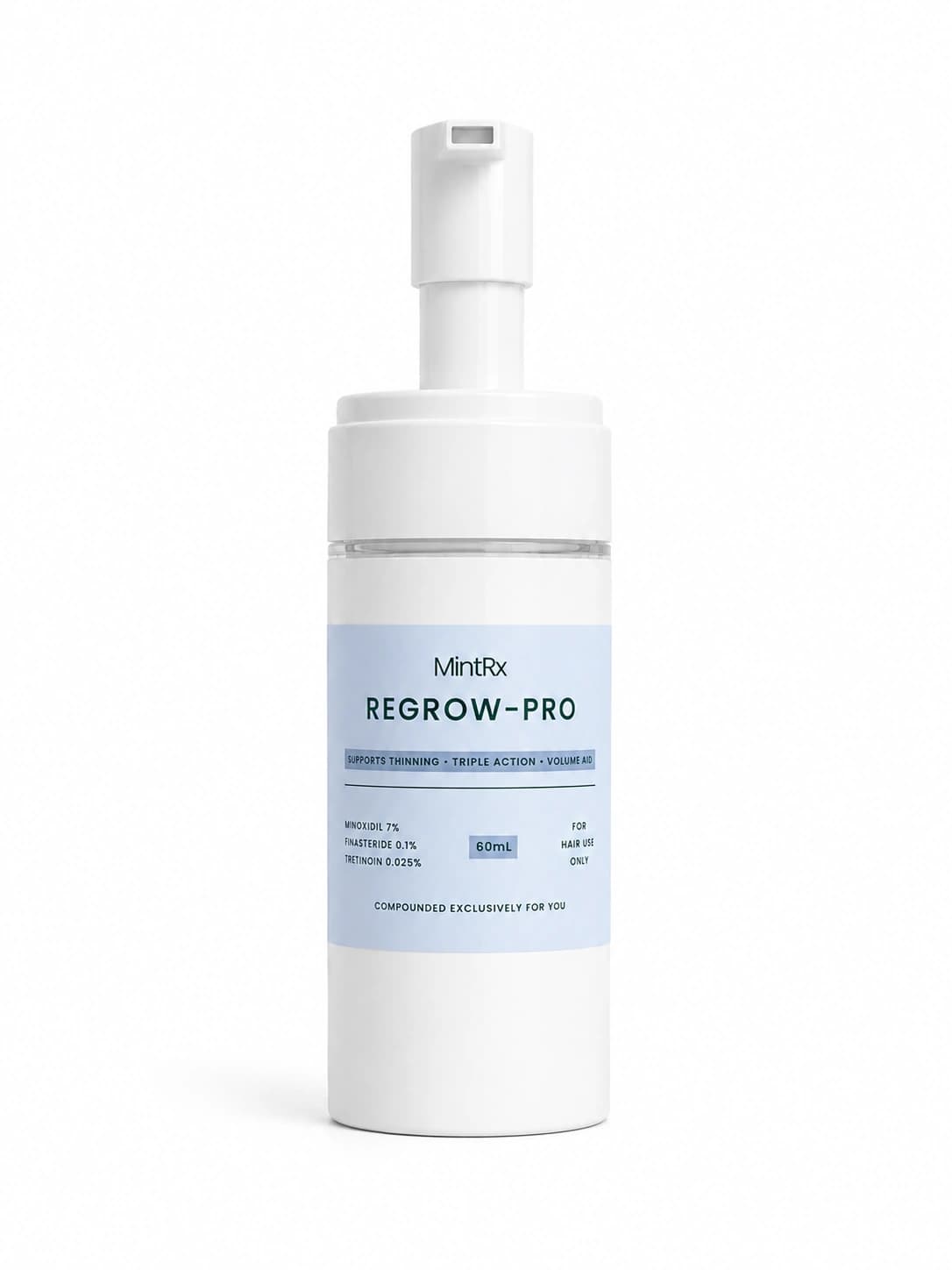
RegrowPro is a prescription foam combining minoxidil 7%, finasteride 0.1% and tretinoin 0.025%. Minoxidil supports the growth phase, finasteride lowers DHT at the scalp, and tretinoin helps turnover and absorption. You apply it to a dry scalp once a day and leave it on at least four hours, following your label.
For women, it's an option when you can no longer become pregnant, such as after menopause, and aren't pregnant or trying, because finasteride can affect a developing male baby. Wash your hands after applying, keep your treated scalp away from anyone who could become pregnant for at least four hours, and protect your hairline from sun, since tretinoin raises sun sensitivity. Some extra shedding in weeks 2 to 8 can be a normal start. Don't add oral finasteride or oral minoxidil unless your prescriber does. Here's what to ask about topical finasteride side effects.
Finasteride: a DHT blocker for women who can't become pregnant
Finasteride lowers DHT, the hormone that shrinks follicles in pattern hair loss. It's the same finasteride approved for male pattern hair loss, and a dermatologist may prescribe it for a woman with hereditary hair loss who cannot get pregnant. It works differently from minoxidil, so the two can be paired.
Results in women vary more than in men. A review of 65 studies in women found several reporting improvement in female pattern hair loss across a range of doses, though the 12-month study in the Propecia label didn't show a difference in postmenopausal women. Give it a fair trial with photos and a set check-in.
The firm rule: it's never used by anyone who is or could become pregnant, and anyone in your home who could be pregnant shouldn't handle crushed or broken tablets. Our comparison of topical and oral finasteride covers the trade-offs.
How to tell it's working
Judge any of these in months, not mornings. The AAD says to give minoxidil about six to 12 months, and prescription medicines for female pattern hair loss the same. Extra shedding in the first two to eight weeks of minoxidil can happen and stops as regrowth begins.
- Take photos every two to three months, same light, same part, dry hair.
- Note your part width and the hair in your brush or drain.
- Write down side effects and when they started.
- Check in when your provider planned, and sooner for anything that worries you.
More on how to assess progress with prescription hair loss treatment.
How MintRx care works
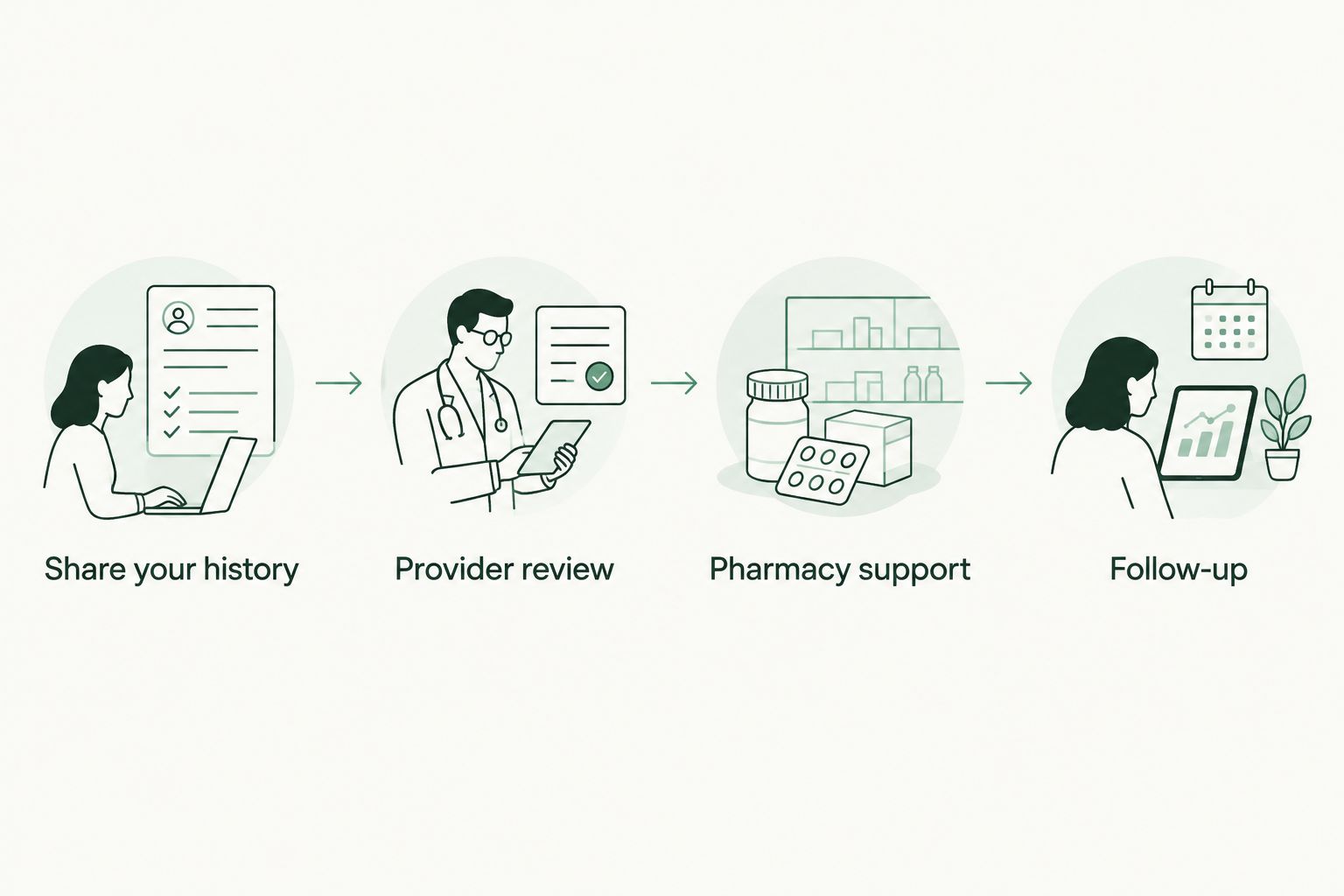
You answer health questions online, and a licensed provider decides whether a prescription fits you. A licensed pharmacy dispenses it with your name and directions on the label, and availability varies by state. A MintRx pharmacist can help before you start or after it arrives, with side effects, combining treatments or how it's going. See what happens after you start treatment online and whether women can get prescription hair loss treatment online.
Which treatment should you choose?
- Want the simplest routine, or topical minoxidil didn't work? Ask about oral minoxidil.
- Early thinning and fine with a daily scalp step? Start with topical minoxidil.
- Can't become pregnant and want minoxidil plus a DHT blocker in one step? Ask about RegrowPro.
- Can't become pregnant and want to add a DHT blocker? Ask about finasteride.
- Curious about spironolactone? Ask your dermatologist; MintRx doesn't offer it for hair loss.
- Sudden patches, scalp pain or redness? Get an in-person exam first.
Bring your questions: What's causing my thinning? What should I notice first, and when? Which side effects should I call about? When will we decide whether it's working? Our guide to choosing a prescription hair loss treatment goes deeper, or explore MintRx hair loss treatments.
FAQ
What's the best prescription hair loss treatment for women?
Low-dose oral minoxidil is a strong choice for many women, especially if a scalp product hasn't fit your routine. Women who can no longer become pregnant can also consider finasteride or RegrowPro foam.
Is oral minoxidil better than topical minoxidil for women?
Same medicine, different route. The tablet reaches your whole scalp and skips daily application; the scalp product avoids whole-body effects like lightheadedness or swelling.
Can women use finasteride or RegrowPro?
Yes, when pregnancy isn't possible. For women who can no longer become pregnant and aren't pregnant or trying, a provider may prescribe finasteride tablets or RegrowPro foam. Neither is used by anyone who is or could become pregnant.
How long does it take to see results?
Plan on 6 to 12 months to judge any of these. Extra shedding in the first two to eight weeks of minoxidil can be normal, and photos every few months make progress easier to see.
Can stress, a new baby or low iron cause hair loss?
Yes. Shedding after childbirth, illness or stress is common and usually settles within six to nine months. Thyroid problems and low iron can thin hair too, so mention them at your visit.
Sources
AAD: Female pattern hair loss
AAD: Hair loss diagnosis and treatment
DailyMed: Minoxidil tablets label
DailyMed: Propecia label
Randolph and Tosti: Oral minoxidil for hair loss review
Vano-Galvan et al.: Low-dose oral minoxidil safety
Hu et al.: Finasteride in women, systematic review


