

Care Guide
How do you assess progress with prescription hair loss treatment?
How to judge prescription hair loss treatment: matched photos, realistic timelines for finasteride and minoxidil, early shedding, and what not to wait on.

Compare matched photos against your starting point, give the medicine the time its evidence calls for, and judge progress against the goal you set at the start. For many people, hair loss that stops getting worse is a real result, even without obvious regrowth. What you shouldn't do is raise the dose, add a product or stop treatment because of one discouraging photo.
The mirror is a poor judge. Lighting, hair length, styling and a damp scalp can make the same head of hair look thinner or fuller from one day to the next. A simple, repeatable record does a better job, and it gives your provider something real to look at.
Haven't chosen a treatment yet? Start with how to choose a prescription hair loss treatment. This guide is about what comes after.
Reviewer: Nathan Parker, PharmD.
How do you assess progress with prescription hair loss treatment?
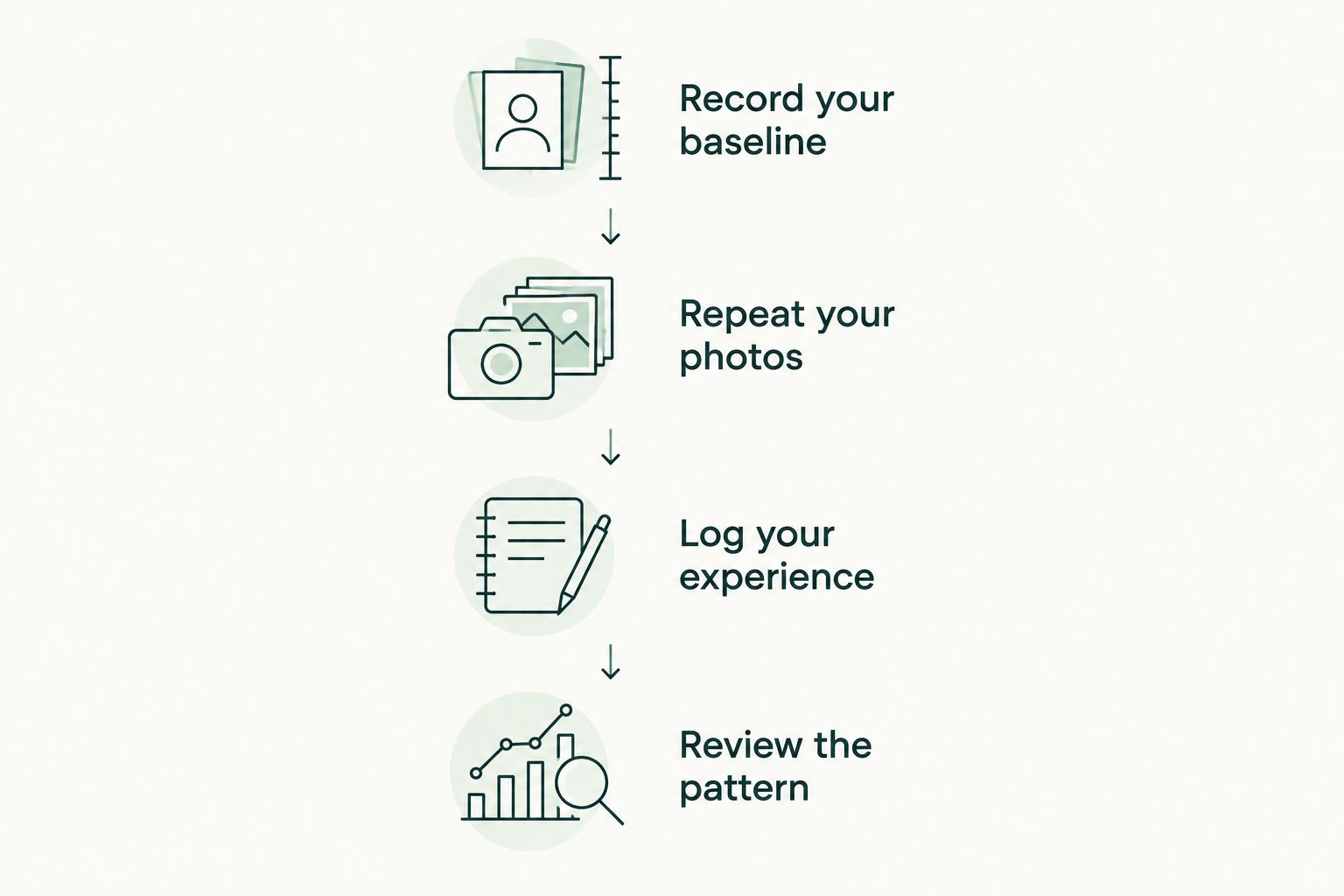
Use the same observation method each time, then review the pattern with your provider. A record that shows what changed and what stayed consistent is more useful than a collection of unrelated pictures.
- Record your baseline. Take clear photographs before treatment, if possible. Note where thinning bothers you, when it started, and what you want treatment to accomplish.
- Repeat your photos. Keep the lighting, camera position, hair condition, and part placement as consistent as possible. Include the same scalp areas rather than photographing only whichever spot looks different that day.
- Log your experience. Record missed doses, interruptions, side effects, scalp symptoms, and noticeable changes in shedding. Describe observations rather than assigning a diagnosis yourself.
- Review the pattern. Bring the photos and notes to your planned follow-up. Ask whether the findings suggest stabilization, regrowth, an unclear response, or a need to reconsider the diagnosis.
Make each photo a fair comparison
Choose a setup you can repeat without special equipment. Use the same room and light source, keep your camera at a similar distance, and avoid switching between wet and dry hair. Photograph your hairline, part, or crown according to the areas your provider wants to monitor.
Record meaningful changes in hair length, coloring, styling products, or concealing fibers. These details do not invalidate a photo, but they affect how the comparison should be read. Keep original images without filters or appearance edits.
Compare matching views, not your best photo with your worst photo. If the conditions differ substantially, repeat the photograph before drawing a conclusion.
This is how the finasteride studies judged results too. An independent panel compared standardized photographs of each man's head, taken the same way each time, rather than relying on how anyone felt about their hair that week. You don't need studio lighting, but the same room, light, distance and hair condition get you most of the way. Take them on the schedule you and your provider agree on. Daily photos mostly measure lighting.
What counts as progress besides new hair growth?
Discuss your starting goal before deciding whether treatment is working. Maintaining coverage and recovering lost density are different goals, and a photograph cannot tell you whether an outcome meets your expectations unless those expectations are clear.
Keeping what you have is not a consolation prize. In the long-term finasteride studies described in the Propecia prescribing information, every man still on placebo at five years (a small group) had measurable further hair loss, compared with about a third of the men taking finasteride. Stable coverage can mean the treatment is doing its job.
Useful observations include:
- Stable coverage: The same scalp areas do not appear progressively more exposed under comparable conditions.
- Improved coverage: Matching photographs show less visible scalp or a fuller-looking part.
- Shedding changes: Your notes show a change in what you notice during washing or brushing, interpreted alongside other findings.
- Treatment tolerability: You can follow the prescribed plan without unresolved medication problems.
None of these observations establishes success by itself. Stable-looking hair over a short interval does not prove a lasting response, and fewer hairs in the shower do not confirm increased density. Your provider should interpret the overall pattern.
Avoid setting a personal pass-or-fail threshold based on a social media photograph. Someone else's diagnosis, treatment, hairstyle, and observation period may differ from yours.
How long should you give it?
Different medicines run on different clocks. Use your exact product's label and your provider's plan, but here's what the evidence says.
- Finasteride tablets: The Propecia prescribing information says daily use for three months or more is generally needed before benefit is observed. It also says stopping reverses the effect within 12 months, so 'it worked, so I'll stop' usually means giving back the gain.
- Topical minoxidil: The American Academy of Dermatology says it usually takes about 6 to 12 months to see how well minoxidil works. The Rogaine foam labels say results may show at 2 months for men using it twice daily or 3 months for women using it once daily, while some people need at least 4 to 6 months.
- Oral minoxidil tablets: These are prescribed off-label for hair loss, so there's no hair-loss timeline on the label. Ask your provider when they want to reassess.
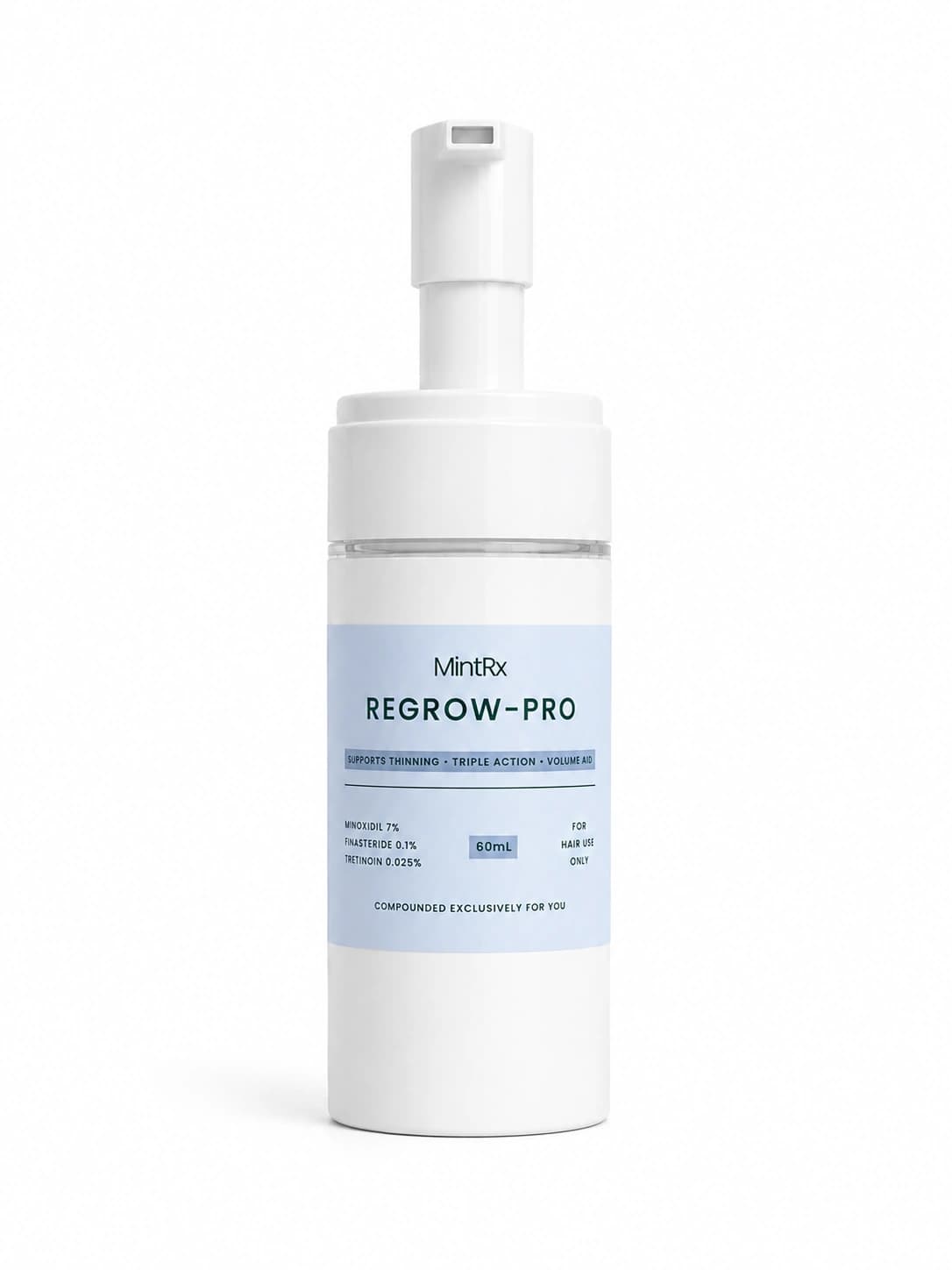
- Compounded foams such as RegrowPro: Ask what review point fits your exact formula. A timeline from a different product doesn't automatically carry over.
Three months isn't a pass-or-fail date for any of these. It's an early checkpoint.
What if shedding gets worse at first?
It can happen with minoxidil. The AAD notes that during the first two to eight weeks of minoxidil, you may notice a temporary increase in hair loss that stops as hair begins to regrow. That's one more reason to agree on a review point before you start, so an early spike doesn't push you to quit.
Early shedding isn't a reason to ignore everything else. Distinct bald patches, a sore, red or scaly scalp, or heavy shedding that keeps going past that early window should be checked, not written off as part of the process.
Side effects don't wait for your next progress check
A review covers two things: your hair, and how you're doing on the medicine. Don't save side effects for the appointment.
- Finasteride: Tell your prescriber about sexual changes, low mood, or breast tenderness or a lump. Seek help right away for any thoughts of self-harm.
- Oral minoxidil: The prescribing information carries a boxed warning for serious heart-related effects. Seek urgent care for chest pain, trouble breathing or fainting. Contact your prescriber promptly about new swelling, quick unexplained weight gain or a racing heartbeat.
- Topical treatments: Report irritation that doesn't settle, a rash that spreads past your scalp, or new hair growth on your face.
Does less shedding mean my treatment is working?
Less shedding is useful information, but it does not prove that prescription hair loss treatment is working. Washing frequency, brushing habits, and hair length affect what you notice, so interpret shedding alongside matched photographs and your provider's assessment.
You do not need to count every shed hair unless your provider specifically requests a measurement method. Focus on a repeatable description rather than an exact-looking number you cannot measure reliably.
What if I see no improvement after 3 months?
For finasteride, 3 months or more is generally necessary before benefit is observed, according to the FDA-approved Propecia prescribing information. No visible improvement at that point does not, by itself, establish treatment failure; review your treatment history and next assessment point with your provider.
For minoxidil, the AAD's 6 to 12 month window is the better guide. For anything else, ask your provider for the review point that fits your exact treatment.
Should I stop once my hair looks better?
Do not stop or change your prescription solely because your photographs improve. Finasteride's prescribing information states that its effect reverses within 12 months after withdrawal; other treatments require their own discussion about continuation and stopping.
A follow-up should address what happens next, including whether the benefit remains worth the treatment burden and risks. That decision belongs with your licensed provider.
What happens at a treatment review?
Bring your baseline images, recent matching photos, medication list, and notes about how you actually used the prescription. Mention side effects even if they seem unrelated or feel uncomfortable to discuss. Clear information helps your provider assess the treatment safely.
Be honest about missed doses and breaks. They're part of the history your provider is reading, so report them rather than trying to make up for them.
Ask focused questions:
- Does this record show stabilization, regrowth, or an unclear response?
- Is the original diagnosis still the best explanation?
- Are any symptoms a reason for further evaluation?
- What should I track before the next review?
- What would justify continuing, changing, or stopping this plan?
A licensed provider makes prescribing and treatment-change decisions; submitting information doesn't guarantee a prescription or a change. If you have medication questions before the review, talk with a MintRx pharmacist, and this guide explains when to call the MintRx pharmacy team versus your provider. If the plan is working and you're due for more, here's how to request a refill in the patient portal.
FAQ
What's the best way to track prescription hair loss treatment at home?
Use matching scalp photographs and a brief treatment log. Keep lighting, hair condition, camera position, and photographed areas consistent, then review the pattern with your licensed provider.
Can hair loss treatment work without obvious regrowth?
Stabilizing hair loss can be a meaningful treatment goal even without obvious regrowth. Your provider should interpret stable coverage against your diagnosis, starting point, and observation period.
How soon should I expect finasteride to show a benefit?
Finasteride generally requires daily use for 3 months or more before benefit is observed, according to the FDA-approved Propecia prescribing information. This does not guarantee a visible response or establish a universal stopping point. Topical minoxidil usually needs about 6 to 12 months.
Should I increase my dose if my photos look unchanged?
Do not increase your dose based on unchanged photographs. Ask your licensed provider to review the timeline, diagnosis, consistency of use, and safety before making a treatment decision.
Do I need to wait for my next review if I have side effects?
Do not wait for a routine progress review to report medication side effects. Contact your provider or pharmacist promptly; seek emergency care for severe symptoms such as chest pain or difficulty breathing.
Can a MintRx pharmacist help me understand my prescription?
A MintRx pharmacist can help with medication questions, including instructions and side-effect concerns. Your licensed provider remains responsible for prescribing and treatment decisions.
One last thing
Your most useful progress photo is not necessarily the sharpest one. It is the one you can reproduce: the same view, similar lighting, and the same hair condition. Consistency makes a modest change easier to discuss honestly.
Before your next review, gather your baseline photos, matching recent photos and a short note on how you actually used the medicine. You can also compare MintRx's hair-loss options if you and your provider decide the plan needs to change.
Sources
- DailyMed: Propecia prescribing information
- DailyMed: Minoxidil tablets prescribing information
- DailyMed: Women's Rogaine 5% foam Drug Facts
- DailyMed: Men's Rogaine 5% foam Drug Facts
- American Academy of Dermatology: Hair loss diagnosis and treatment
- American Academy of Dermatology: Female pattern hair loss

