

How do you choose a prescription hair loss treatment?
Choose a prescription hair loss treatment by diagnosis, safety, and formulation. Compare finasteride and minoxidil, risks, and the next steps in care.
Start by finding out why you're losing hair. If the cause is pattern hair loss, the next choice is between treatments that address different parts of the problem: finasteride lowers DHT, a hormone involved in male pattern thinning, while minoxidil can help support hair growth. Your health history, pregnancy considerations and the routine you can realistically maintain help narrow the options. A bigger milligram number is not a better treatment plan.
You can compare MintRx's hair-loss options before deciding what to discuss with your provider.
Choose prescription hair loss treatment by diagnosis, safety and a routine you can maintain, not tablet strength.
Finasteride lowers DHT in male pattern hair loss; oral minoxidil use for hair loss is off-label.
Preserving existing hair can be a meaningful result, even without dramatic regrowth.
Sudden, patchy, painful or inflamed hair loss needs assessment before routine treatment selection.
Why this matters
More hair in the shower and a slowly widening part can lead you to the same search page, but they don't always have the same cause. Recent illness, childbirth or weight changes can matter just as much as the pattern you see in the mirror. That's why the first useful question is, ‘What kind of hair loss am I treating?’ The American Academy of Dermatology explains how clinicians investigate hair loss, including when an examination or testing may help.
Start with the pattern, not the product
Bring a description of when the loss started, where it occurs and whether your scalp feels different. Pattern thinning, temporary shedding and scalp disease don't all need the same plan.
Describe the pattern. Explain whether you see gradual thinning, a widening part, a receding hairline, distinct patches or increased shedding.
Share your history. Include recent illness, childbirth, major weight changes, previous hair treatments and a complete medication and supplement list. That list helps identify interactions and overlapping effects.
Review safety. Discuss pregnancy plans, possible pregnancy, breastfeeding, heart conditions, blood pressure concerns and symptoms such as dizziness or swelling. Cardiovascular history is especially relevant to oral minoxidil.
Compare formulations. Ask why an oral or topical option fits the suspected diagnosis and your health history. Be honest about the routine you can maintain, and include cost and refill access in that conversation.
Plan follow-up. Agree on what progress means, how side effects will be assessed, which symptoms need contact and when to reassess treatment.
If you've tried treatment before, say what actually got in the way: irritation, missed applications, cost, side effects or not knowing how long to give it. ‘I tried it’ tells your provider less than ‘I used it consistently for this long, and this is what happened.’
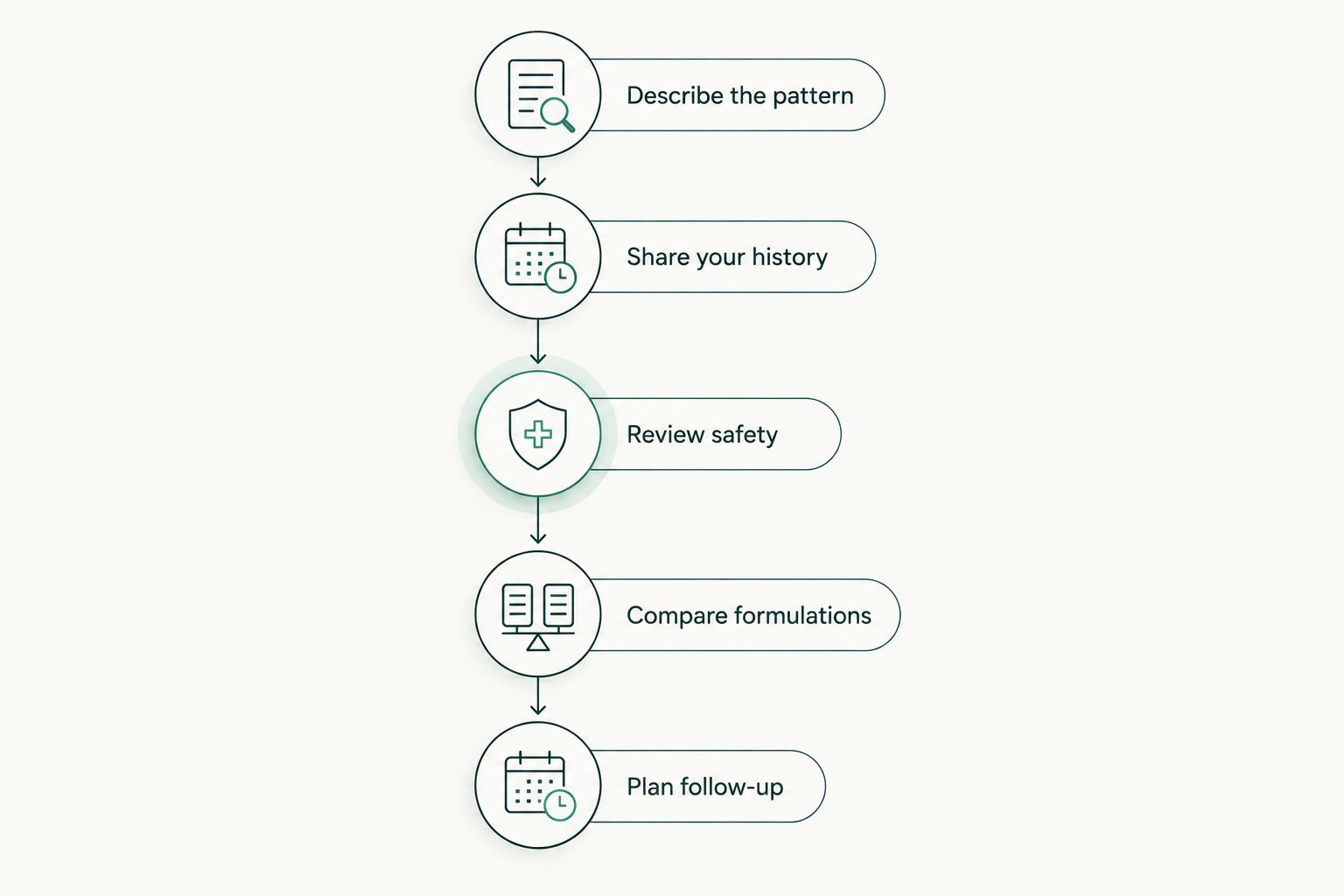
The treatment decision follows an assessment of the hair loss and your health history.
Photos can help document change, but they don't explain every cause of hair loss. An in-person examination or testing can help when the history and visible pattern leave questions unanswered. That doesn't mean everyone needs laboratory tests.
Compare the options without treating them as equivalents
These options work differently and have different precautions. The table is a starting point for the conversation, not a personal prescription.
OptionWhy you might consider itWhat to weighFinasteride 1 mg tabletsAn oral option for men with male pattern hair loss that lowers DHT and can slow further thinning.Ongoing treatment; possible sexual adverse effects; pregnancy-related handling precautions.Oral minoxidil 2.5 mg tabletsA scalp-free routine to discuss if applying a topical product is difficult or irritating.Off-label for hair loss; cardiovascular history, blood pressure, fluid retention and unwanted hair growth need consideration.Topical minoxidilA scalp-applied, nonprescription option that can support growth without assuming a prescription pill is necessary.Consistent application; scalp irritation and unwanted hair growth; follow the exact product's labeling.
Don't choose by the milligram number. Finasteride 1 mg and minoxidil 2.5 mg contain different medicines. You can't rank their effectiveness by those numbers, and tablet strength isn't a personal dosing instruction.
Finasteride: a prescription option for male pattern hair loss
Finasteride reduces the conversion of testosterone to dihydrotestosterone, or DHT, a hormone involved in male pattern hair loss. It can slow further thinning and improve growth in some men, but it isn't a general treatment for every cause of shedding. FDA labeling for Propecia specifies use in men and doesn't indicate it for women or children.
The trade-off includes ongoing treatment and possible sexual side effects, including decreased libido, erectile dysfunction and ejaculation disorders. Discuss existing sexual symptoms and concerns before starting, and ask how to report changes. You don't have to assume that tolerating a side effect is the price of treating your hair loss.
People who are pregnant or could become pregnant should not handle crushed or broken finasteride tablets because of the potential risk to a male fetus. That handling precaution matters even when the person taking the medicine isn't pregnant.
Oral minoxidil: an off-label hair loss option
Oral minoxidil is a prescription medicine approved to treat severe hypertension, or high blood pressure. Its use for hair loss is off-label, meaning the FDA hasn't approved the oral formulation for that purpose. It still requires a provider's assessment of your diagnosis and health history.
A tablet avoids applying medicine to your scalp, but it can cause unwanted hair growth, fluid retention and changes in heart rate or blood pressure. The oral-minoxidil prescribing information carries a boxed warning that includes fluid around the heart, which can become serious, and worsening angina, a type of chest pain.
Your provider should explain what monitoring your proposed regimen needs. Seek urgent medical care for chest pain, trouble breathing or fainting. Contact your prescriber promptly about new swelling, rapid unexplained weight gain or a racing heartbeat. Don't wait for a routine hair-progress check to raise those symptoms.
Topical minoxidil: a nonprescription comparison point
Topical minoxidil belongs in the conversation even when you're researching prescriptions. Some topical products are FDA-approved and available without a prescription for specified patterns of hair loss. The intended users and instructions depend on the exact product, so follow its labeling.
A scalp-applied option doesn't assume you need a pill. The practical trade-offs include consistent application, scalp irritation and unwanted hair growth.
A pill may be easier to fit into your day, but that doesn't automatically make it more effective. In a 24-week randomized trial in men with pattern hair loss, oral minoxidil 5 mg daily did not outperform topical minoxidil 5% twice daily on the main hair-density measures. The study did not test every dose or every patient group. The practical question is which route fits your health history and which routine you can keep up with, not which one sounds stronger.
Penha and colleagues published that trial in JAMA Dermatology in 2024. It tested 5 mg oral treatment, not a prescribed 2.5 mg regimen, and not showing superiority doesn't prove the treatments are equivalent. A secondary assessment of photographs favored oral treatment at the crown. Those study regimens describe the research, not instructions for your dose.
Prescription treatment doesn't have to mean a tablet
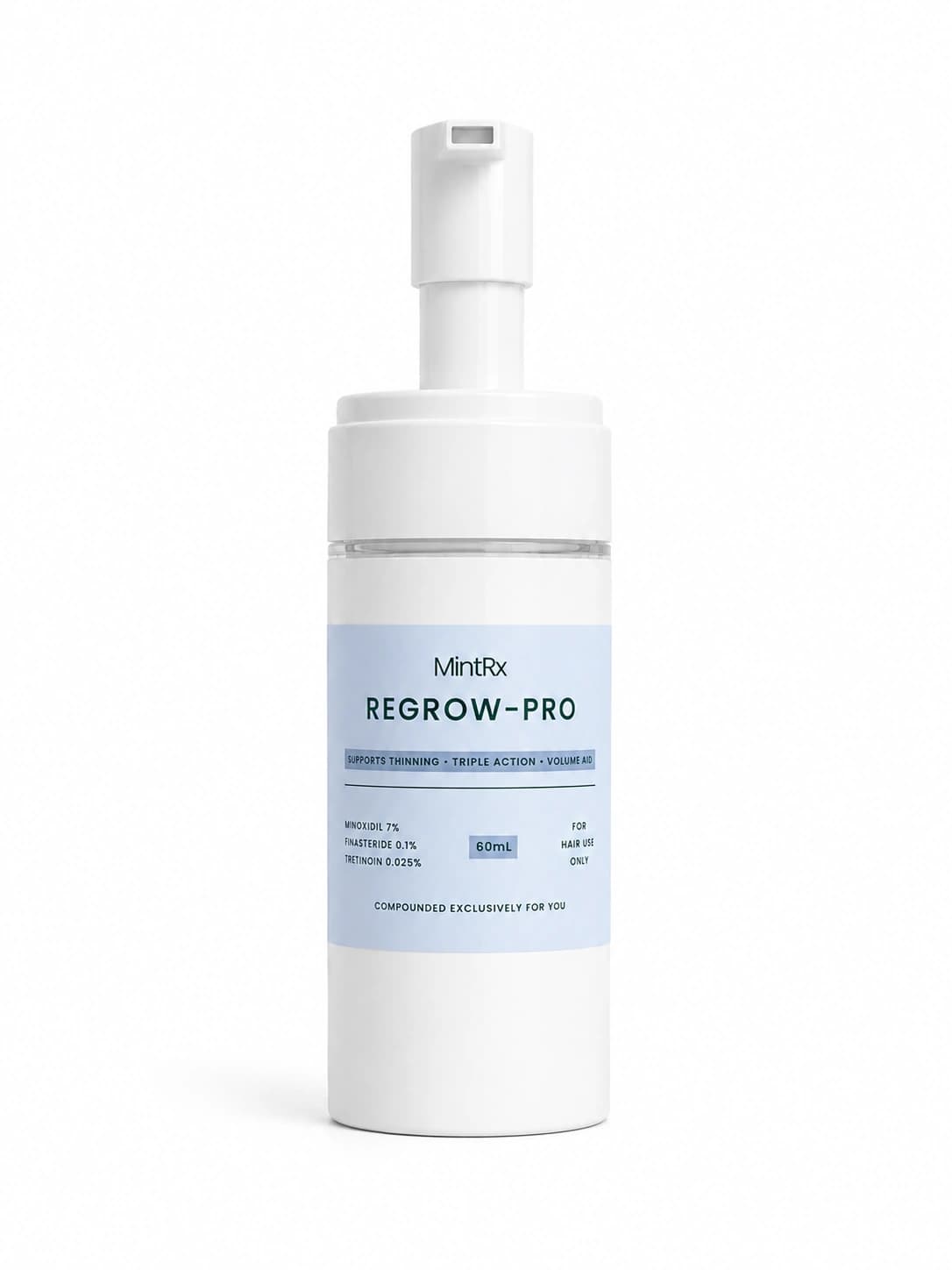
Prescription topical treatment is another category to discuss. MintRx's RegrowPro compounded foam combines minoxidil, finasteride and tretinoin in one scalp-applied product. It is not the same as over-the-counter minoxidil, and compounded medications are not FDA-approved. Ask why that exact combination fits your needs rather than assuming more ingredients make it better.
How long should you try treatment before judging it?
Keeping more of the hair you have can be a meaningful result. Before starting, ask what success would look like for you: less progression, improved coverage or both. A five-year finasteride study and its trial extensions found that ongoing treatment slowed further loss and improved scalp hair growth in men with male pattern hair loss. That is a long-term treatment goal, not a promise to restore your old hairline.
The Propecia prescribing information says daily use for three months or more is generally needed before benefit is observed. That is not a pass-or-fail deadline. Agree on when to reassess, and compare photos taken under similar conditions rather than trying to judge progress in the mirror every morning.
The five-year study was published in 2002. Its findings support long-term benefit during treatment, not guaranteed regrowth. Finasteride requires ongoing treatment to sustain benefit; the prescribing information states that withdrawal leads to reversal of its effect within 12 months. That exact timeframe doesn't apply to minoxidil.
Do you need a prescription for every hair loss treatment?
No. Some topical minoxidil products are available without a prescription, while finasteride and oral minoxidil require prescribing. Prescription status doesn't tell you which option fits your diagnosis or which has fewer risks for you.
Sudden loss, distinct patches, scalp pain, redness, inflammation or signs of scarring need assessment rather than an automatic prescription for pattern thinning.
What happens when you explore treatment online?
You can explore options online without having to figure out every medication detail yourself. Talk with a MintRx pharmacist about what you've tried, what worries you and which parts of the routine are unclear. A licensed provider decides whether a prescription is appropriate and whether your treatment plan should change; completing an intake does not guarantee approval.
If you're new to online care, here's what happens after you start treatment online. For account or order questions, contact MintRx Client Care. Use the secure care path for sensitive medical details, not the public contact form.
FAQ
What is the best prescription hair loss treatment for me?
The best prescription hair loss treatment depends on the cause of your hair loss, your health history, pregnancy considerations and the routine you can maintain. Start with the diagnosis, then compare the benefits and trade-offs of the exact options.
Is finasteride better than oral minoxidil?
Neither medicine is better for everyone. Finasteride lowers DHT and is FDA-approved for male pattern hair loss, while oral minoxidil use for hair loss is off-label; their precautions and side effects differ.
Can women take prescription treatment for hair loss?
Women can discuss prescription hair loss treatment, but the right option depends on the cause of loss and individual risks. Propecia labeling doesn't indicate finasteride for women, and pregnancy, pregnancy plans and breastfeeding affect treatment choices.
Is oral minoxidil FDA-approved for hair loss?
No. Oral minoxidil is approved for severe hypertension, and its use for hair loss is off-label. Approval of some topical minoxidil products for hair loss doesn't extend to the oral formulation.
How soon can I expect finasteride to work?
The Propecia prescribing information says daily use for three months or more is generally needed before benefit is observed. That isn't a pass-or-fail deadline or a promise of regrowth; agree on when to reassess, including whether further thinning has slowed.
Can I combine finasteride and minoxidil myself?
Don't put together a prescription combination or change your treatment plan yourself. The exact formulations, your health history and possible side effects need assessment before combining treatments.
Who answers medication questions after an online prescription arrives?
Your pharmacist can help with medication instructions, interactions and side-effect questions. Your licensed provider handles treatment changes, and Client Care handles orders and account support. This guide explains when to call the MintRx pharmacy team. Severe symptoms need urgent care, not a routine support message.
This guide explains when to call the MintRx pharmacy team.
One last thing
Bring your medication list, your hair-loss timeline and your main concern to the conversation. You don't need to know every medication detail to explain what matters to you.
Clinically reviewed by Nathan Parker, PharmD
Last reviewed: November 6, 2026
Sources
Keep reading
Need help with your next step?
Start with Client Care. We can help with account and order questions or route you to the right clinical or pharmacy resource.