
Care Guide
How do topical and oral finasteride options differ?
Topical and oral finasteride both lower DHT, but exposure, evidence, approval and handling differ. What really changes when finasteride goes on your scalp.

Both forms of finasteride do the same basic job: they lower DHT, the hormone behind male pattern thinning. What changes with the route is how much reaches the rest of your body, how much evidence stands behind the exact product, whether it's FDA-approved and who else in your home could be exposed.
The finasteride 1 mg tablet is FDA-approved for male pattern hair loss and has years of study behind it. Topical finasteride, alone or mixed with minoxidil, isn't FDA-approved, and its evidence depends on the exact formula. A scalp product may mean less finasteride in your bloodstream, but less isn't none, and topical doesn't automatically mean safer.
Reviewer: Nathan Parker, PharmD.
How do topical and oral finasteride differ?
| What changes | Finasteride 1 mg tablet | Topical finasteride |
|---|---|---|
| How you use it | One tablet a day, as prescribed | Applied to the scalp; directions depend on the formula |
| What reaches your blood | Works through your whole body | Much lower in one studied spray, but still measurable; not established for every formula |
| FDA status | Approved for male pattern hair loss in men | No FDA-approved topical product |
| Long-term evidence | Studies out to five years | One large 24-week trial of a finasteride-only spray |
| Handling at home | Coated tablets; anyone pregnant shouldn't handle broken or crushed ones | No coating; it can transfer from treated scalp and hands |
| Other ingredients | None | Often combined with minoxidil or other actives, each with its own side effects |
This table compares routes. It isn't a recommendation for you. If you're still deciding between finasteride and minoxidil altogether, start with our guide to choosing a prescription hair loss treatment.
Oral finasteride: an FDA-approved 1 mg formulation
Finasteride tablets labeled for male pattern hair loss contain 1 mg of finasteride. That strength identifies the approved hair loss formulation; it is not an instruction to start treatment or adjust a prescription yourself.
Finasteride reduces DHT by blocking an enzyme called 5-alpha reductase. In susceptible hair follicles, DHT contributes to the progressive thinning associated with male pattern hair loss. Finasteride does not treat every cause of shedding.
The FDA-approved Propecia prescribing information states that 3 months or more of use is generally necessary before benefit is observed. It also states that stopping treatment leads to reversal of the effect within 12 months. The tablet also has the deepest track record. In a five-year study and its extensions, men who stayed on finasteride had slower further loss and better scalp hair growth than men on placebo. These are labeling statements, not a promise about your individual response.
The practical benefit is that a tablet does not require applying medicine to your scalp. The trade-off is exposure throughout the body and the need to discuss adverse effects, including decreased sexual desire, erectile dysfunction, and ejaculation changes.
The prescribing information also includes postmarketing reports of sexual dysfunction continuing after discontinuation. Reports do not establish how often this happens, but they belong in an informed treatment discussion.
Finasteride also lowers PSA, a prostate blood test. In the Propecia studies of men 18 to 41, average PSA fell from 0.7 to 0.5 ng/mL over a year. Tell whoever orders a PSA test that you take finasteride. A confirmed rise from your lowest on-treatment value should be checked even if it's still in the normal range. Bring up mood changes, sexual health concerns and fertility questions with your prescriber too.
Topical finasteride: scalp application does not mean scalp-only exposure
There's no FDA-approved topical finasteride. The FDA's 2025 safety alert says so directly, and it notes that absorption through the skin into the bloodstream is expected. Compounded preparations are made for a prescription, but FDA doesn't review them for safety, effectiveness or quality before they're sold. If approval is your main question, our guide to whether topical minoxidil with finasteride is FDA-approved goes deeper.
What does the research show? The strongest trial so far tested a 0.25% finasteride-only spray in 458 men for 24 weeks. Hair counts improved more than with placebo and were similar to the 1 mg tablet group. Peak finasteride levels in the blood were more than 100 times lower with the spray, yet blood DHT still fell by about 35%, compared with about 56% on the tablet. So the spray still acted on the whole body, just less. The study was industry-funded, about 3 in 10 participants didn't finish, and 24 weeks can't tell you about long-term or rare side effects.
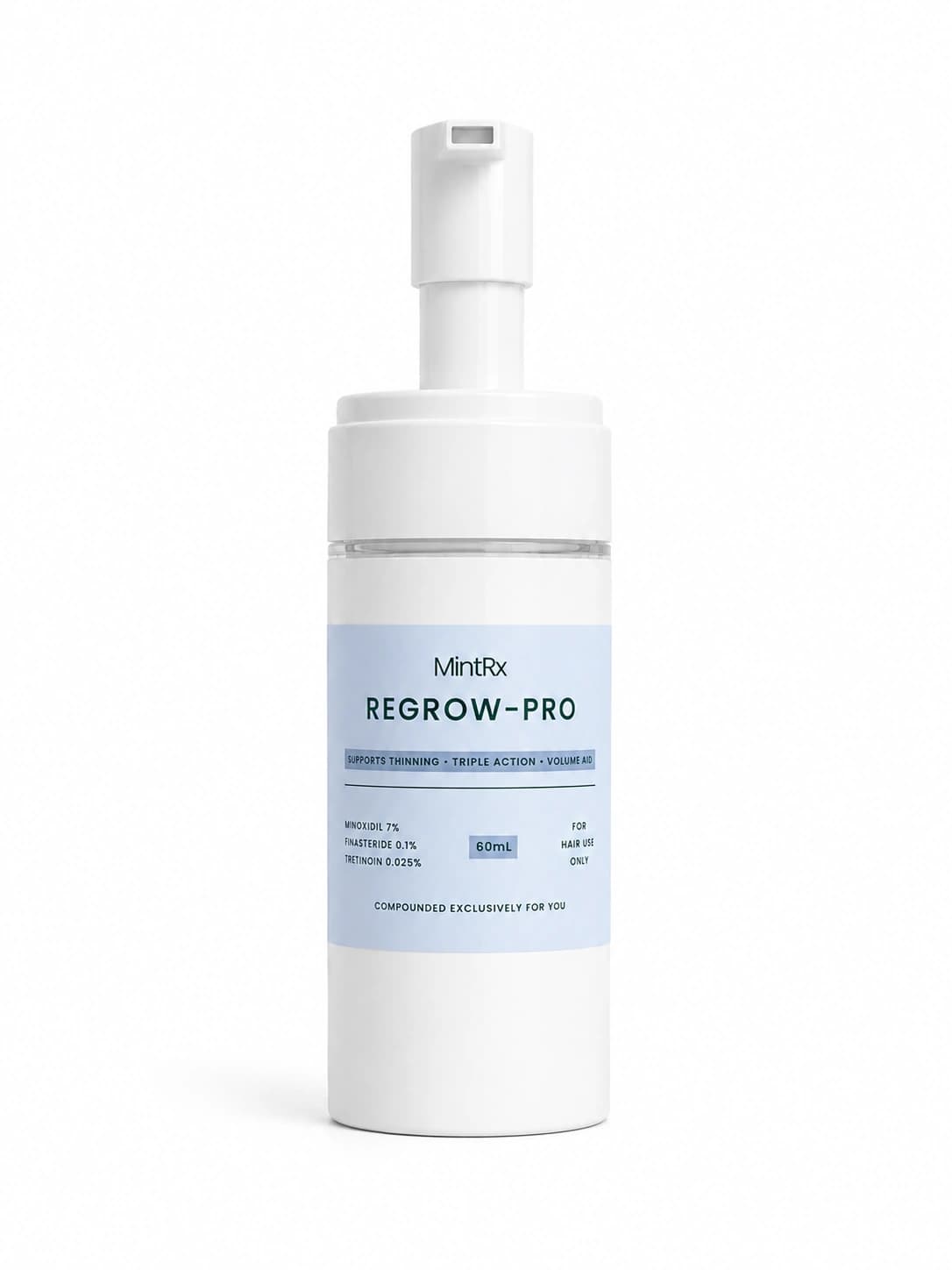
That result doesn't carry over to every formula. MintRx's RegrowPro compounded foam contains finasteride 0.1% with minoxidil 7% and tretinoin 0.025%: a different strength, base and ingredient list from the spray that was studied. Ask what evidence applies to the formula you'd actually use.
Handling is a real difference. Finasteride tablets are coated, which prevents contact during normal handling as long as they aren't broken or crushed. A foam or spray has no coating, and FDA warns it can transfer to others through contact with the treated area.
Pregnancy exposure needs particular attention because finasteride can harm the development of a male fetus. Someone who is pregnant or could become pregnant should not handle crushed or broken finasteride tablets; topical exposure also requires precautions. Ask the pharmacist how to prevent exposure to another person.
Both forms can also be options for women, but only when pregnancy isn't possible. For women who can no longer become pregnant, such as after menopause, and who aren't pregnant or trying to conceive, a provider may prescribe finasteride tablets or a topical such as RegrowPro.
How do you decide which route fits?
These questions separate the two routes better than the label 'topical' does:
- Did you have side effects on the tablet? Lower exposure is the main reason people ask about topical, but it hasn't been shown to prevent side effects in someone who already had them on the tablet. Tell your provider exactly what happened and when.
- Can you keep up with the routine? A tablet is one step. A foam means daily application to a dry scalp and washing your hands afterward.
- Who do you live with? A pregnant partner or young children change the handling conversation much more for a topical than for intact tablets.
- Do you also want minoxidil? A combination foam adds minoxidil's and tretinoin's side effects. Separate products can be adjusted one at a time.
- Is PSA testing in your future? Tell the clinician about finasteride in any form you use.
If you're weighing side effects in detail, ask your pharmacist to walk through each ingredient in the product you're considering.
Can you use minoxidil and finasteride together?
Yes, many hair-loss plans use both, but the exact products matter. Taking a finasteride tablet with a separate minoxidil product isn't the same as using one compounded foam that contains both. And don't double up on finasteride: RegrowPro's directions say not to combine it with oral finasteride or dutasteride unless your prescriber explicitly approves. Give your provider and pharmacist the full ingredient list of everything you use on your scalp or take by mouth.
How long should you wait before judging oral finasteride?
3 months or more is generally necessary before benefit is observed, according to FDA-approved Propecia prescribing information. Your provider should explain when to assess your response; that labeling statement does not set the timeline for a different topical or compounded formulation.
What happens when you explore treatment online?
A licensed provider decides whether a prescription fits, and switching between the tablet and a topical is a new prescription, not just a new bottle. Submitting an intake doesn't guarantee approval. Here's what happens after you start treatment online. Before you decide, you can talk with a MintRx pharmacist about the exact formulations you're comparing, and this guide explains when to call the MintRx pharmacy team versus your provider.
FAQ
What's the main difference between topical and oral finasteride?
Oral finasteride is swallowed, while topical finasteride is applied to the scalp and can still enter the bloodstream. In the US, oral finasteride has an FDA-approved hair loss formulation; topical finasteride does not.
Can topical finasteride cause sexual side effects?
Topical finasteride can cause systemic adverse effects, and the FDA has received reports that include sexual symptoms. Applying it to the scalp does not eliminate absorption into the bloodstream.
Can someone else be exposed to my topical finasteride?
Another person can be exposed through contact with topical finasteride. Ask the dispensing pharmacist for prescription-specific handling and contact precautions, especially where pregnancy exposure is possible.
How quickly does oral finasteride work for hair loss?
3 months or more is generally necessary before benefit is observed, according to FDA-approved Propecia prescribing information. Individual response varies, and this timeline does not establish when a compounded topical formula will work.
Should I switch from oral finasteride to a topical formula?
That's a decision to make with your licensed provider. Bring your reason for switching, what happened on the tablet and the exact topical formula. Don't use both at once unless that's the plan your prescriber set.
Can women use oral or topical finasteride?
Only when pregnancy isn't possible. For women who can no longer become pregnant and aren't pregnant or trying to conceive, a provider may prescribe finasteride tablets or RegrowPro foam.
Who answers medication questions after treatment arrives?
The MintRx pharmacy team supports medication questions, while licensed providers make prescribing and treatment decisions. Client Care handles account and order questions and routes requests.
One last thing
The word topical describes where you apply a medicine, not where all of it stays. That distinction matters more than whether a formula sounds convenient.
Talk to a MintRx pharmacist about the exact formulation you are considering, including its ingredients, handling precautions, and the questions to take to your licensed provider.
Sources
- DailyMed: Propecia prescribing information
- Finasteride Male Pattern Hair Loss Study Group: Long-term five-year experience with finasteride 1 mg, European Journal of Dermatology, 2002
- Piraccini and colleagues: Topical finasteride spray phase III randomized trial, 2022. Published correction
- FDA: Compounded topical finasteride safety alert, April 22, 2025
- FDA: Compounding and the FDA, Questions and Answers

