
Care Guide
What should you ask about topical finasteride side effects?
Topical finasteride can still reach your bloodstream. What to ask about mood and sexual changes, scalp irritation and protecting the people you live with.

Start with this: putting finasteride on your scalp doesn't mean it stays there. Some of it reaches your bloodstream, so the questions worth asking go beyond itching and redness. Ask which sexual or mood changes to watch for, how to keep the medicine away from the people you live with, and what each ingredient in your formula can do. If your foam or spray also contains minoxidil or tretinoin, each one brings its own side effects.
You don't need to know the medical terms. You just need clear answers before you start.
Reviewer: Nathan Parker, PharmD.
Still deciding whether prescription treatment is right for you? Start with our guide to choosing a prescription hair loss treatment. Wondering whether these formulas are FDA-approved? The short answer is no, and this guide to topical minoxidil with finasteride explains what that means.
Six questions to ask before you start
- What exactly is in my formula? Every active ingredient, its strength, and whether it's a foam, spray or solution.
- Which effects can show up beyond my scalp? Sexual changes, mood changes and anything that means I should call right away.
- What does each other ingredient add? Minoxidil and tretinoin have their own side effects.
- How do I keep it off other people? Hands, pillowcases, hats, towels, and partners or children who touch my hair.
- What do I do if something changes? Who I contact, and which symptoms mean urgent care instead of a message.
- What research applies to my exact formula? The same ingredients, strength and base, or something different?
The FDA's safety alert on compounded topical finasteride explains why these questions matter. FDA says absorption through the skin into the bloodstream is expected, and the reports it received described problems like those seen with finasteride tablets, including erectile dysfunction, lower libido, depression, anxiety and suicidal thoughts. Voluntary reports can't tell you how often a problem happens or prove the medicine caused each one, but they're a good reason to have this conversation before you start.
Does topical finasteride cause fewer side effects than the tablet?
Maybe less exposure, but not zero, and not proven for every formula. In a 24-week randomized trial of a finasteride-only spray in men with pattern hair loss, blood levels of finasteride were far lower than with the 1 mg finasteride tablet. Blood DHT still dropped by about a third on the spray, compared with a little over half on the tablet. Sexual side effects were uncommon in every group, but a 24-week study can't settle rare or long-lasting effects.
That trial tested one 0.25% spray containing finasteride alone. It doesn't tell you what a foam with a different strength, other ingredients and a different base will do. Lower exposure is plausible for some formulas, but 'topical' isn't a promise. You can see both routes on MintRx's hair-loss options page.
Which scalp reactions should you ask about?
Ask about itching, redness, burning, dryness, and flaking. These symptoms can relate to an active ingredient, the liquid or gel carrying it, another scalp product, or an underlying skin condition.
FDA's alert also lists local reactions with topical finasteride: irritation, redness, dryness or scaling, stinging and burning.
Minoxidil solutions and foams do not necessarily contain the same inactive ingredients. Ask the pharmacist to identify those ingredients rather than assuming every topical preparation will feel the same.
Useful questions include:
- “What irritation should I report rather than work through?”
- “Does my current scalp condition affect whether this is appropriate?”
- “Can my other scalp products increase irritation?”
- “Who should assess a rash that spreads beyond the application area?”
Do not assume a stronger reaction means a stronger treatment effect. A painful or inflamed scalp deserves assessment, not reassurance based on hair-growth expectations.
Follow the instructions for your prescribed preparation, not an online routine written for another formula. Do not increase applications, combine products, or use a skin-needling device with treatment unless your licensed provider has addressed that plan.
Can topical finasteride cause sexual or mood changes?
Yes, it can. Finasteride lowers DHT whether it's swallowed or absorbed through the skin. The Propecia prescribing information lists decreased libido, erectile dysfunction and ejaculation problems, plus postmarketing reports of depression, suicidal thoughts and sexual problems that continued after stopping. Those reports come from the tablet, but FDA's alert describes the same kinds of problems with topical products, and most of those reports said symptoms continued after the product was stopped.
Here's the practical part. Before you start, take an honest note of where things stand with your mood, sex drive and erections. It can feel awkward, but a baseline makes it much easier to say later, 'This changed about three weeks after I started,' instead of guessing.
Tell your prescriber promptly about new sexual changes, low mood, or breast tenderness, a lump or nipple discharge. Don't accept a promise that a topical formula can't cause lasting symptoms. The safety information doesn't support that promise.
If you have thoughts of suicide or feel unable to stay safe, call or text 988 in the US, or call 911 if you're in immediate danger. Don't wait for a portal message.
What if your formula also has minoxidil or tretinoin?
A combination formula means more than one set of side effects. Finasteride questions don't cover minoxidil, and neither covers tretinoin.
Minoxidil: Some minoxidil can be absorbed from the scalp too. The Men's Rogaine 5% foam Drug Facts and Women's Rogaine 5% foam Drug Facts tell users to stop and ask a doctor for chest pain, rapid heartbeat, faintness or dizziness, sudden unexplained weight gain, swollen hands or feet, or unwanted facial hair. Chest pain, trouble breathing or fainting needs urgent care. Tell your prescriber about heart conditions and blood pressure medicines before you start.
Tretinoin: It can cause redness, peeling, dryness and stinging, and it makes skin more sensitive to sun. The tretinoin cream prescribing information says severe redness, swelling, blistering or crusting is a reason to stop and contact your prescriber. A hat helps protect a thinning scalp.
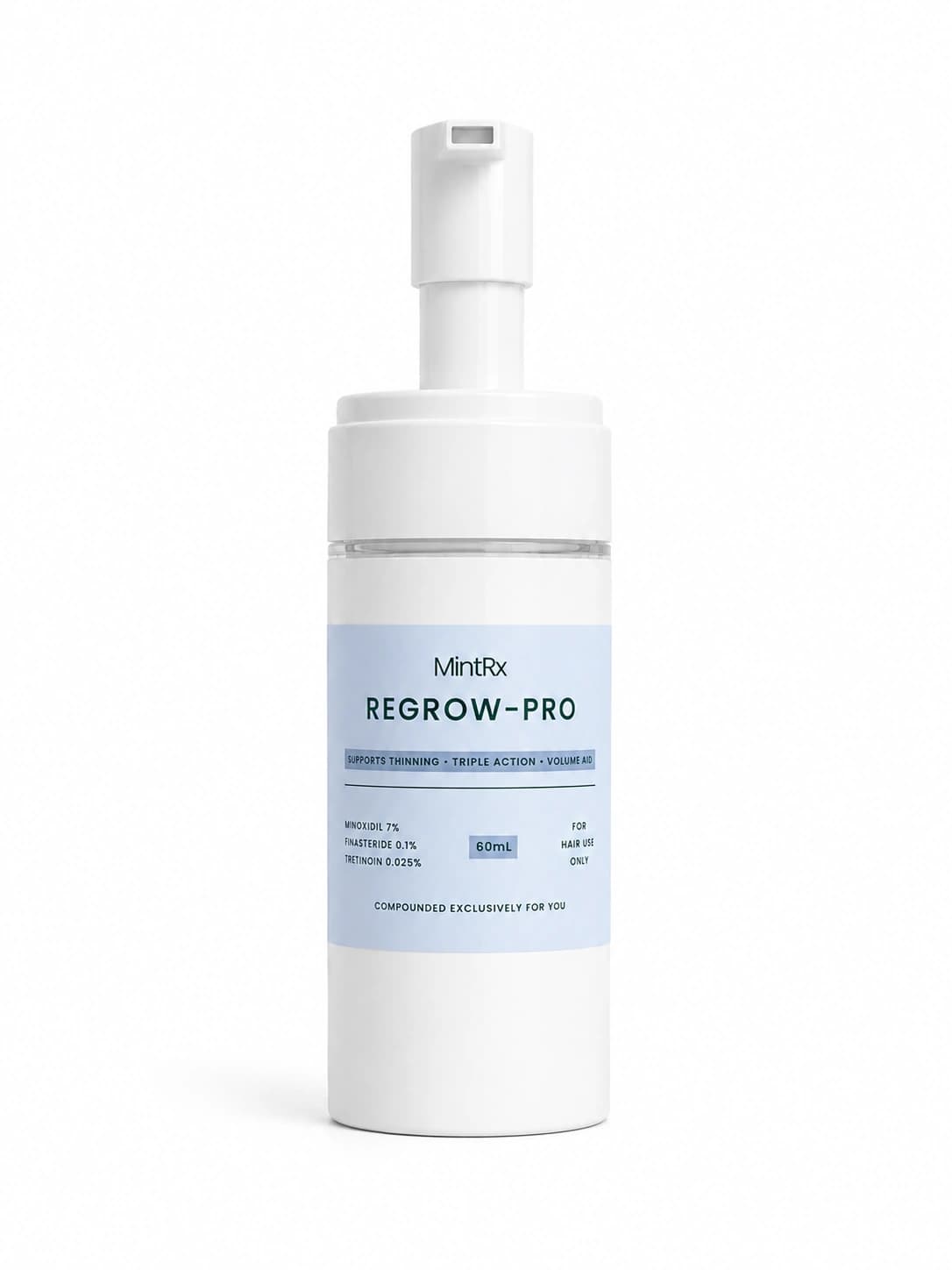
MintRx's RegrowPro compounded foam is one example of a combination: minoxidil 7%, finasteride 0.1% and tretinoin 0.025%. The labels above describe different products, so use them to know which symptoms to report, not to predict how often they happen with a combination foam.
Bring the bottle, or a clear photo of the label, to any medication review. 'Hair foam' doesn't tell anyone what's inside.
How do you protect other people from exposure?
This is the side effect people forget: the one that can happen to someone else. FDA notes that topical finasteride carries a greater potential for exposure to others, especially women, through transfer of the applied product. Finasteride tablets have a coating that prevents contact during normal handling. A foam or spray doesn't.
Finasteride must not be used in pregnancy because it can affect the development of a male fetus. If anyone in your home is pregnant or could become pregnant, bring it up before you start. Ask the dispensing pharmacist for the handling directions for your exact product: washing your hands, letting it dry, pillowcases and hats, and contact with treated skin. Don't borrow a waiting time from a different product.
That's also why women can use finasteride or RegrowPro only when pregnancy isn't possible. For women who can no longer become pregnant, such as after menopause, and who aren't pregnant or trying to conceive, a provider may prescribe either one. The side-effect and handling questions in this guide apply to them too.
Keep it away from children and pets. If someone is accidentally exposed, wash the area with soap and water and call your pharmacist or prescriber for advice right away.
Who to call, and when
A licensed provider decides whether a prescription fits and whether your plan should change; submitting an intake doesn't guarantee a prescription. Your pharmacist can walk through ingredients, handling and side-effect questions before or after your treatment arrives, so talk with a MintRx pharmacist when something feels off. This guide explains when to call the MintRx pharmacy team versus your provider or Client Care.
Chest pain, trouble breathing, fainting or swelling of the face or throat needs urgent care, not a routine message.
FAQ
Can topical finasteride cause side effects throughout my body?
Yes. Topical finasteride can enter the bloodstream, and the FDA has described systemic adverse-event reports involving compounded topical products. Scalp application does not guarantee that effects stay local.
Is topical finasteride safer than taking a finasteride tablet?
Not automatically. A studied finasteride-only spray produced much lower blood levels than the tablet but still lowered DHT throughout the body. That result doesn't transfer to every compounded formula.
What should I ask about a combination foam?
Ask about each ingredient's risks, including tretinoin if it's in your formula, the exact concentration and formulation, accidental transfer, and the plan for new symptoms. A combination needs its own assessment rather than assumptions based on either ingredient alone.
Is compounded topical finasteride FDA-approved?
No. There is no FDA-approved topical finasteride product, alone or combined with other ingredients. Ask what evidence supports the exact formula you're considering.
Can I use topical finasteride if someone in my household is pregnant?
Discuss household exposure with your provider and pharmacist before use. Finasteride can transfer from treated areas, and exposure during pregnancy can harm the development of a male fetus.
Does scalp itching mean my hair treatment is working?
No. Itching is not proof that a hair-loss treatment is working. Irritation can reflect the ingredients, another scalp product, or a skin condition that needs assessment.
Who should I contact if I notice side effects after delivery?
Contact your pharmacist or prescribing provider for medication-related symptoms and instructions. Seek urgent care for severe symptoms rather than waiting for a routine response; Client Care can help route nonurgent requests.
Can women use topical finasteride?
Only when pregnancy isn't possible. For women who can no longer become pregnant and aren't pregnant or trying to conceive, a provider may prescribe a topical such as RegrowPro or finasteride tablets.
One last thing
Bring the bottle, not just the ingredient name. The label gives your provider or pharmacist details that a search result cannot: the actual formula, concentration, and instructions you received.
Then ask one more question: 'What should I do if this doesn't suit me?' A good answer names who to contact, which symptoms need urgent care and how a change in plan gets decided.
If you're new to online care, here's what happens after you start treatment online.
Sources
- FDA: Compounded topical finasteride safety alert, April 22, 2025
- Piraccini and colleagues: Topical finasteride spray phase III randomized trial, 2022. Published correction
- DailyMed: Propecia prescribing information
- DailyMed: Men's Rogaine 5% foam Drug Facts
- DailyMed: Women's Rogaine 5% foam Drug Facts
- DailyMed: Tretinoin cream prescribing information (labeled for acne)


