Hair Loss
Best prescription hair loss treatments for men compared
Compare finasteride, oral minoxidil and RegrowPro for male pattern hair loss: what each does, who it fits, what to expect and how to track progress.

For many men with male pattern hair loss, the strongest plan covers two jobs: protect the hair you have and help thinning hairs grow back. Finasteride handles the first by lowering DHT, the hormone that shrinks hair follicles. Minoxidil handles the second by keeping follicles in their growth phase longer. You can take them as tablets, use them on your scalp, or get both in one foam.
The right pick depends on your pattern, your health history and the routine you'll actually keep. You can also compare MintRx's hair loss treatments.
Reviewer: Nathan Parker, PharmD.
The options at a glance
| Option | What it does | A good fit if |
|---|---|---|
| Finasteride 1 mg tablet | Lowers DHT to keep your hair | You want the best-studied pill |
| Oral minoxidil 2.5 mg | Supports growth across the scalp | You want growth with no scalp routine |
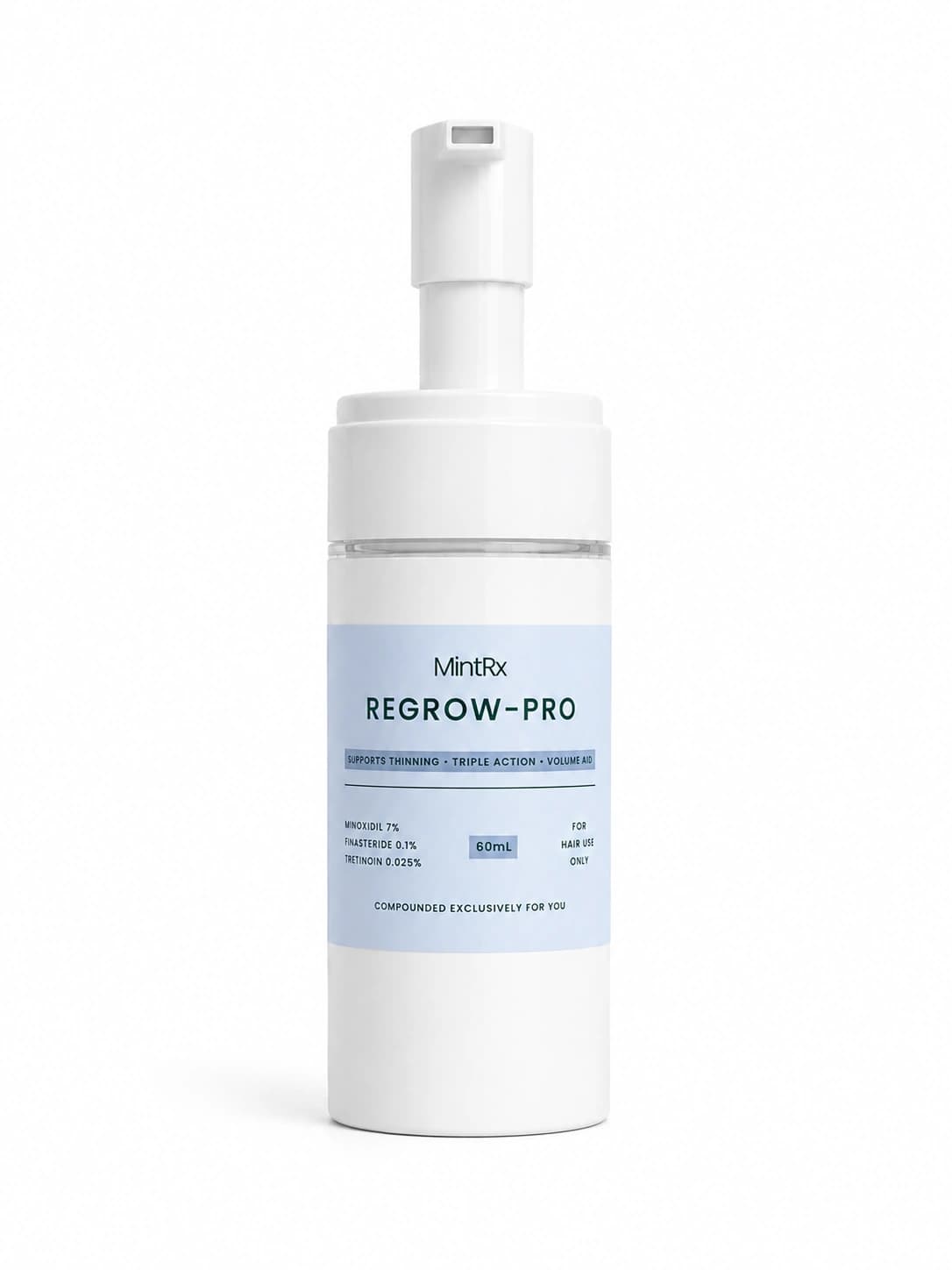
| RegrowPro foam | Finasteride plus minoxidil on the scalp | You'd rather not take a pill |
| Topical minoxidil 5% | Store-bought growth support | You want to start without a prescription |
Not sure what kind of hair loss you have? Start with how to choose a prescription hair loss treatment.
Finasteride 1 mg: the foundation for keeping your hair
Finasteride 1 mg tablets lower DHT, the hormone behind thinning at the crown and hairline. It's the same finasteride approved for male pattern hair loss, with the longest track record here. The American Academy of Dermatology notes that finasteride slows further hair loss in about 80% to 90% of men, and men who start early are more likely to regrow some hair. In a five-year study and its extensions, men on finasteride kept their gains while men on placebo kept losing ground.
It's one small tablet a day, no scalp routine, and it works as long as you take it. The Propecia prescribing information notes the effect fades within 12 months of stopping.
Most men notice no change in their sex life. In the main trials, lower sex drive, erection changes and less ejaculate each showed up in 1 or 2 men out of 100, close to placebo, and went away in men who stopped and in most who kept going. Some men have reported effects that continued after stopping, so bring up any change in desire, erections or mood early. Two practical notes: anyone who is or could become pregnant shouldn't handle crushed or broken tablets, and tell whoever orders a PSA test that you take finasteride, because it lowers that number. Here's how topical and oral finasteride differ.
Minoxidil: the growth side of the plan
Minoxidil helps thin hairs grow thicker and longer.
Oral minoxidil 2.5 mg is one tablet a day that reaches your whole scalp, with no foam on your pillow. In a 24-week randomized trial in men, a daily minoxidil tablet and twice-daily topical minoxidil gave similar results on the main density measures, and the tablet did better on crown photos. That trial used a 5 mg tablet, so take it as a guide to the route, not your dose.
Minoxidil tablets were first made for high blood pressure at much higher doses, so your provider reviews your heart history and blood pressure medicines first. At hair doses, side effects are usually mild. In a study of 1,404 people taking low-dose oral minoxidil for hair loss, the most common was extra hair on the face or body (about 15%), while lightheadedness, fluid retention and a faster heartbeat each affected under 2%. Lightheaded when you stand, ankle swelling or a racing heartbeat? Tell your prescriber. Chest pain, trouble breathing or fainting needs emergency care.
Topical minoxidil 5% is the nonprescription version. The Men's Rogaine foam label says results may show at 2 months, though some men need 4 months. Scalp irritation and the twice-daily routine are what usually get in the way.
RegrowPro: finasteride and minoxidil in one foam
RegrowPro is a compounded prescription foam with minoxidil 7%, finasteride 0.1% and tretinoin 0.025%. You apply it to a dry scalp once a day and leave it on at least 4 hours. It covers protection and growth without a pill, and the tretinoin helps scalp turnover and penetration.
On the scalp, less finasteride reaches the rest of your body, though some still does. A review of seven small trials found topical minoxidil plus finasteride beat minoxidil alone on hair density and thickness. Those trials used other formulas, so they support the approach rather than this exact foam.
Keep a partner who could become pregnant from touching your treated scalp for 4 hours, protect a treated hairline from the sun, and skip stacking it with oral finasteride, dutasteride or oral minoxidil unless your prescriber directs it. Here's what to ask about topical finasteride side effects.
Dutasteride: a stronger DHT blocker for later
Dutasteride blocks both forms of the enzyme that makes DHT. In a 24-week trial of 917 men, dutasteride 0.5 mg grew more hair than finasteride 1 mg. Its approved use is an enlarged prostate, it lingers in your body for months after you stop, and MintRx doesn't offer it. After a fair trial of finasteride, it's a question for a dermatologist.
Keeping your hair counts as a win
Treatment can win two ways: stopping the loss and growing some back. Stopping the loss is the most common result, and it matters, because male pattern hair loss keeps progressing on its own. Regrowth is more likely when you start early.
Give any plan 6 to 12 months. Finasteride's label says benefit takes three months or more of daily use, and the AAD puts finasteride results at about 6 months and minoxidil at 6 to 12. Some men see extra shedding in the first weeks of minoxidil. A dermatology chart review of patients starting oral minoxidil describes it as usually starting 2 to 4 weeks in and passing within a few weeks; about 1 in 20 patients there had it. Those hairs were due to fall soon anyway, so keep going and mention it at your check-in.
To tell it's working, take baseline photos of your hairline, part and crown, then repeat them every few months in the same light, angle and hair length. The mirror can't show slow change; matched photos can. Here's how to track progress with prescription hair loss treatment.
Combining treatments
Finasteride and minoxidil work on different parts of the problem, so they pair well. A review of five randomized trials found finasteride plus topical minoxidil worked better than either alone, with similar side effects. Common plans are finasteride with oral or topical minoxidil, or RegrowPro on its own.
How to get treatment you can trust
Where your medicine comes from matters. Look for:
- A prescription after a real review of your health history
- A licensed pharmacy on the label, with your name and directions
- A pharmacist you can actually reach
With MintRx, you answer health questions online and a licensed provider reviews them to decide whether a prescription fits. A licensed pharmacy dispenses it, and availability varies by state. Here's what happens after you start treatment online. Questions about side effects, timing or combining? Talk with a MintRx pharmacist, and see when to call the MintRx pharmacy team.
Which should you start with?
- Want the best-studied way to keep your hair? Start with finasteride.
- Want more growth too? Add minoxidil, as a tablet or on your scalp.
- Rather not take a pill? Look at RegrowPro.
- Not ready for a prescription? Topical minoxidil is a fine first step.
Bring your photos, your medication list and the one thing you most want to change. Ask what result to expect, when you'll check in and what would change the plan.
FAQ
What's the best prescription hair loss treatment for men?
For most men with male pattern hair loss, finasteride is the place to start. It's the same finasteride approved for male pattern hair loss, and it protects the hair you have. Many men add minoxidil for growth, and RegrowPro puts both on the scalp in one foam.
Is finasteride or minoxidil better?
They do different jobs, which is why they pair well: finasteride slows loss, minoxidil drives growth.
Can I use finasteride and minoxidil together?
Yes, it's one of the most common plans. RegrowPro already contains both, so skip adding oral finasteride, dutasteride or oral minoxidil to it unless your prescriber directs it.
How long until I see results?
Give it 6 to 12 months. Early minoxidil shedding usually passes within weeks, and matched photos show progress better than the mirror.
Will finasteride affect my sex life?
Most men notice no change. In the main trials, sexual side effects showed up in 1 or 2 men out of 100, close to placebo, and went away in men who stopped and in most who continued. Some men report effects that lasted after stopping, so tell your prescriber about any change early.
Is low-dose oral minoxidil safe?
It's widely used for hair loss and usually well tolerated; in a study of 1,404 people, lightheadedness, fluid retention and a faster heartbeat each affected under 2%. Your provider checks your heart history first. Chest pain, trouble breathing or fainting needs emergency care.
What happens after I request hair loss treatment from MintRx?
You answer health questions online, and a licensed provider decides whether a prescription fits. A licensed pharmacy dispenses it, and a MintRx pharmacist helps with questions along the way.


