
Hair Loss
How long do hair loss treatments take to work?
See when minoxidil and finasteride may start to help, what less shedding tells you, and how to take photos that show changes in your part or crown.

If your part was getting wider and now looks the same from one photo to the next, that may be the first thing your treatment has done for you. Keeping hair and growing it back are different jobs. For gradual pattern hair loss, think in months: some people see early growth with a minoxidil foam after two or three months, depending on the product. Fuller coverage takes longer to judge. A tablet isn't automatically faster.
Reviewer: Nathan Parker, PharmD.
What does “working” look like?
Slower loss: Your crown used to look thinner with each haircut. Now it looks much the same. That matters if keeping what you have was the goal. One unchanged picture can't tell you what would have happened without treatment, but a series can show whether you're still losing ground.
Less shedding: Maybe you’re clearing your brush less often. Make a note of the trend on similar wash days. That tells you about hair coming out, not whether new hair is filling in your part. You don't need to count every strand.
Visible regrowth: Compare the same spot in two photos. Can you see less scalp along your part or through your crown? That's a different result from finding fewer hairs in the shower. If you’re still choosing a treatment, start with which hair loss treatments help you keep hair and which support growth.
Minoxidil on the scalp: check the box you actually bought
Two over-the-counter foams show why the exact product matters. The men's 5% minoxidil foam label says some men see growth at two months and others need at least four. The women's 5% minoxidil foam label says three months for some women and at least six for others. Both boxes say 5%; they have different directions and different points to check in. Follow your own label. These are first signs of growth, not dates by which your hair should look full.
If there's no regrowth by four months on that men's foam or six months on that women's foam, the respective label says to stop use and ask a doctor. If you are seeing growth, the bigger change can take longer. For example, the American Academy of Dermatology's guide to female pattern hair loss puts judging how well topical minoxidil works at about six to twelve months. Store-bought foam timelines don't tell you when a prescription foam with several ingredients will work. If pregnancy is possible, you're pregnant or you're breastfeeding, ask about the right option before starting.
Finasteride: keeping hair is a result you can miss
For men with male pattern hair loss, finasteride 1 mg tablets lower DHT, a hormone that makes susceptible hair follicles shrink. That can slow further thinning. The finasteride tablet label says it generally takes at least three months of daily use before there's a benefit. The dermatology academy's guide for men puts noticeable results at around six months. So at month three, ask “Is my crown still thinning?” as well as “Can I see new hair?” Keeping the benefit takes continued use.
Mention changes in sex drive or erections to your prescriber, and tell whoever orders a PSA blood test that you take finasteride because it can lower the result. Anyone who is or could become pregnant must not take finasteride or handle crushed or broken tablets. The men's timeline doesn't predict results for women. For women who can no longer become pregnant and aren't pregnant or trying, the comparison of hair loss treatments for women explains when a prescriber might consider finasteride and why the evidence differs.
Oral minoxidil: a different routine, not a shortcut
If applying foam before work keeps getting skipped, a tablet may be easier to stick with. A 24-week trial of oral versus topical minoxidil in men compared a 5 mg tablet taken daily with a 5% solution applied twice daily. The crown photos favored the tablet, but it didn't beat the solution on the main measure: the change in the number of thicker hairs in a measured area at the front and crown. The trial looked at the result at 24 weeks, not which group noticed growth first. It doesn't tell you how fast a 2.5 mg oral minoxidil tablet will work for you.
Minoxidil tablets were originally used for hard-to-control high blood pressure. For hair, a prescriber uses a lower dose off-label and reviews your heart history and blood pressure medicines. Oral minoxidil isn't used for hair loss during pregnancy or breastfeeding. Call your prescriber about new ankle swelling, a racing heartbeat or feeling lightheaded when you stand. Get emergency care for chest pain, trouble breathing or fainting. If you're choosing between a pill and a scalp routine, the comparison of hair loss treatments for men walks through that choice.
Take photos you can actually compare
- Start today, even if you missed taking a “before” picture. With dry hair, take one photo of your usual part or hairline and one of your crown. A friend or your phone timer can help with the crown.
- Repeat every two or three months. Use the same room, light, camera angle and distance. Part your hair in the same place, keep styling products and hair fibers out of both pictures, and note a recent haircut or color change. Wet hair under a bathroom spotlight isn't a fair comparison with dry hair by a window.
- Date the pictures and put the same views side by side. Is the part still widening? Is less scalp showing? Separately, note any change in shedding, missed applications or side effects. For more examples, see how to track progress with prescription hair loss treatment.
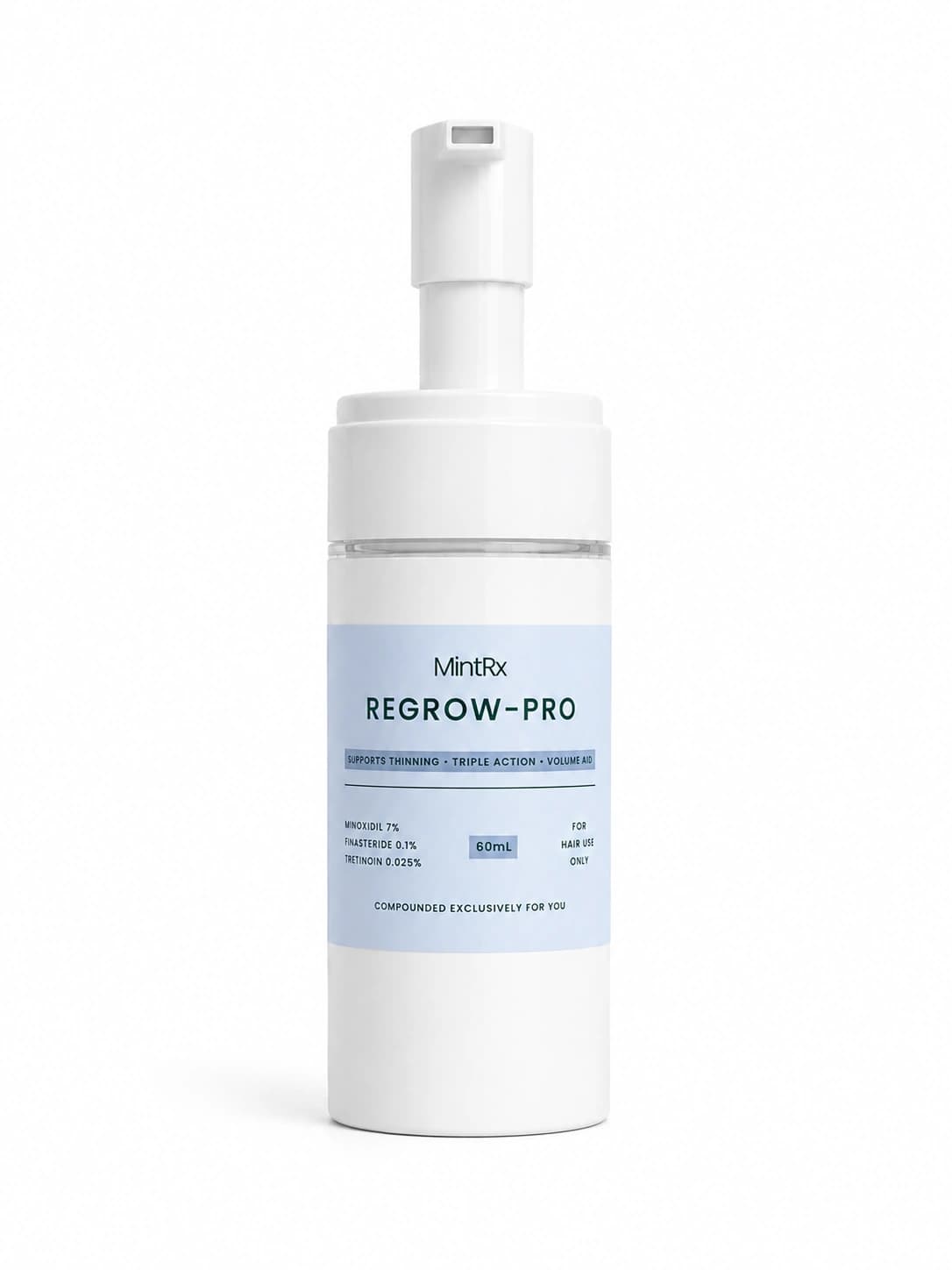
At your check-in, bring those photos and the bottle or box. “I used this foam for three months, but it irritated my scalp and I started skipping days” gives your pharmacist more to work with than “minoxidil didn't work.” Ask what you'd expect to see next and when it makes sense to reassess. You can talk to a MintRx pharmacist about application or side effects, or compare MintRx hair loss treatments if your current routine is hard to keep.
FAQ
What's the fastest treatment for visible regrowth?
One of the earliest signs described on a label is new growth at two months with men's 5% minoxidil foam. That’s a possibility for some men, not a head-to-head win over other treatments or a promise of fuller coverage by then.
Does more shedding mean minoxidil is working?
Some people notice extra shedding in the first weeks of topical minoxidil. Shedding alone can't tell you whether you'll regrow hair. If loss is sudden, heavy or patchy, or your scalp is painful or inflamed, get it examined rather than waiting for your next photo. If your scalp becomes red or irritated on either foam described above, stop using it and ask a doctor, as the label directs.
What if my photos look the same after three months on finasteride?
Compare them with photos from before treatment, if you have them. If your crown was thinning and now looks steady, keeping that hair may be part of the benefit. Three months is an early check for the 1 mg tablet in men, not a final verdict on regrowth.
Would switching from foam to a tablet help sooner?
A tablet can make the routine easier if applying foam gets in the way. The trial in men compared results at 24 weeks; it didn't establish which worked sooner. Bring your product and your photos to the prescriber before switching or adding a second form.
Sources
- DailyMed: Men's Rogaine 5% foam
- DailyMed: Women's Rogaine 5% foam
- DailyMed: Propecia 1 mg tablets
- American Academy of Dermatology: Male pattern hair loss
- American Academy of Dermatology: Female pattern hair loss
- Penha and colleagues: Oral versus topical minoxidil in men
- DailyMed: Minoxidil tablet prescribing information


