
Women's Hormone Therapy
Best treatments for vaginal dryness compared
Compare moisturizers, lubricants and prescription vaginal dryness treatments by symptoms, practical fit and the follow-up that helps you choose.

A moisturizer helps ongoing dryness; a lubricant reduces friction during sex. For persistent menopause-related dryness, low-dose vaginal estrogen is an established prescription option. The best choice depends on your symptoms, their cause and what you can comfortably use.
Menopause is natural. That does not mean you have to accept uncomfortable sex or daily irritation without exploring your options.
Reviewer: Nathan Parker, PharmD.
Start with when and where it bothers you
“Dry all day,” “burning when a product touches the skin,” and “pain with penetration” do not all point to the same next step. Describe where it hurts and whether it happens outside sexual activity too.
Vaginal dryness has several possible causes, including menopause, breastfeeding, certain medicines and irritating products. Dryness is a symptom, not a diagnosis. Persistent pain, unusual discharge, sores or bleeding deserves assessment rather than another product layered on top.
Vaginal dryness treatments at a glance
This compares treatment categories, not medicines MintRx necessarily offers or a weakest-to-strongest ranking.
| Option | When it may fit | What changes the choice |
|---|---|---|
| Low-dose vaginal estrogen | Persistent menopause-related dryness, irritation or painful sex | Formulation, history and comfortable application |
| Vaginal moisturizer | Ongoing dryness or a nonhormonal preference | Ingredients, irritation and everyday comfort |
| Lubricant | Friction during sexual activity | Condom/device compatibility; persistent pain |
| Vaginal prasterone | Postmenopausal moderate to severe painful sex from menopause-related changes | Hormonal vaginal insert; bleeding and cancer history matter |
| Oral ospemifene | Postmenopausal moderate to severe dryness or painful sex | Systemic effects, interactions and clot/cancer history |
| Compounded vaginal hormones | A medical need an appropriate approved medicine cannot meet | Why this preparation is needed |
1. Low-dose vaginal estrogen: treating menopause-related tissue changes
When lower estrogen levels are contributing to dryness and irritation, vaginal estrogen works on those tissue changes rather than simply making sex more slippery. You may hear this group of menopause-related vaginal and urinary changes called genitourinary syndrome of menopause, or GSM.
NICE menopause guidance recommends vaginal estrogen for these symptoms, including in people using systemic HRT. A suitable moisturizer or lubricant can be used alongside it.
A cream involves measuring an amount; an insert has a different handling routine. Tell the pharmacist if measuring, reaching comfortably, cleanup or irritation makes treatment difficult. Follow your own label.
For example, the estradiol vaginal cream 0.01% label covers moderate to severe menopause-related vulvar and vaginal symptoms. Some estrogen can still enter the bloodstream, so your health history and the prescribed amount matter even though you apply it vaginally.
If hot flashes improve but sex still hurts, that deserves its own assessment, not an automatic increase in systemic estrogen. Local and systemic hormone treatments have different jobs. Low-dose vaginal estrogen does not treat hot flashes.
2. Vaginal moisturizers: comfort between sexual activity
A moisturizer supports vaginal comfort between sexual activity. It can be a starting point for mild dryness or a nonhormonal preference. Choose a product intended for vaginal use and follow its directions. Body lotion is not a substitute.
Everyday comfort matters, even if sex is not a current goal. If a product stings or worsens irritation, stop it and ask for advice. Adding several products at once makes it harder to identify what helped or irritated you.
Persistent symptoms need assessment, not an endless search for a more complicated ingredient list.
3. Lubricants: reducing friction during sex
Lubricants reduce friction during sexual activity and can complement other treatment. They do not reverse menopause-related tissue changes.
Choose a texture you find comfortable and check compatibility with condoms and sexual devices. Oil-based lubricants should not be used with latex condoms; water-based or silicone-based products are alternatives. Device compatibility still depends on the manufacturer's directions.
Pain is a reason to pause, not something to push through. If lubrication does not resolve it, seek assessment: dryness may be only part of the problem.
4. Vaginal prasterone: an option for a specific painful-sex problem
Prasterone is DHEA, which the body converts into estrogens and androgens. The approved prasterone vaginal insert is an option for moderate to severe painful sex caused by menopause-related tissue changes. The point is to match the treatment to that cause of pain, rather than treat every kind of dryness the same way.
It may be worth discussing if other vaginal treatments haven't helped or are uncomfortable to use. Discharge can occur. Because DHEA becomes hormones in the body, it isn't a hormone-free option. Unexplained bleeding needs evaluation first, and anyone with current or past breast cancer needs a separate discussion: the label warns about that history and says prasterone hasn't been studied in that population.
5. Oral ospemifene: when a vaginal routine is difficult
If vaginal application is difficult, an oral option may be worth discussing. Ospemifene changes estrogen activity in different tissues; its prescribing information includes moderate to severe vaginal dryness and painful sex caused by menopause-related tissue changes. Its drug-class name is selective estrogen receptor modulator.
The tradeoff is that a pill affects more than the vaginal tissues. Ospemifene can cause hot flashes and carries boxed warnings about endometrial cancer and cardiovascular problems. It isn't an option with unexplained bleeding, estrogen-dependent cancer, or a history of blood clots, stroke or heart attack. The label also says not to use it with known, suspected or past breast cancer. These are reasons to review your history before choosing it, not reasons to leave dryness untreated.
Do not combine ospemifene with estrogen or other estrogen agonist/antagonist medicines. Bring your full medication list for interaction review, including occasional medicines.
6. Compounded vaginal hormones: a specific need, not a stronger tier
Compounding can have a role when an appropriate approved medicine cannot meet a specific need, such as avoiding an inactive ingredient. The pharmacist and prescriber should explain what problem the customization addresses.
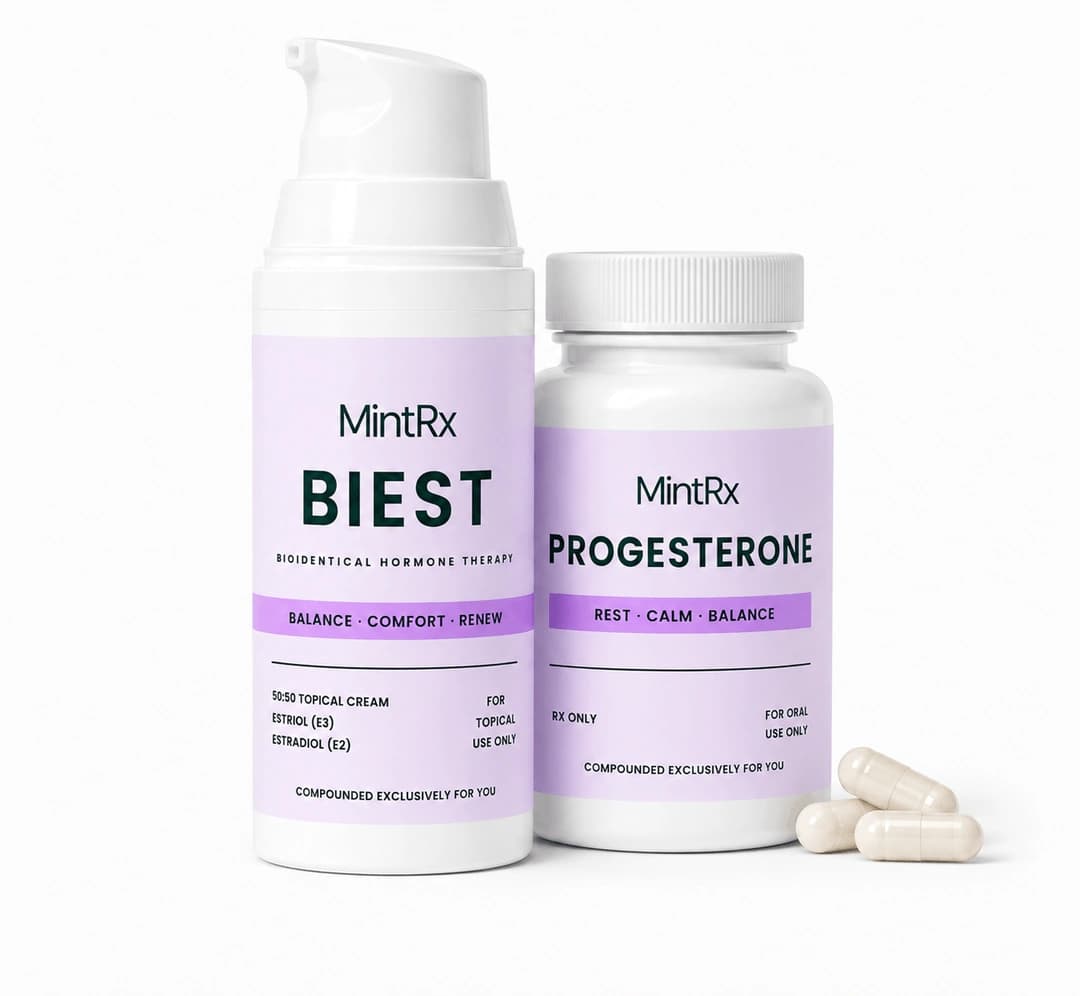
Vaginal options built into MintRx's Female HRT/TRT program include commercial estradiol cream and compounded estriol or estriol/DHEA cream. These are different preparations, not a package everyone receives. Estriol and estradiol are different estrogens; check the name on your label.
Compounded medicines are not FDA-approved or reviewed by FDA for safety, effectiveness or quality before marketing. Studies of an approved estradiol product or prasterone insert don't establish the same results for a compounded combination. The reason to customize is a specific need, not an assumption that more ingredients mean more relief.
Ask: “What need does this formulation address, and how will we decide whether it helps?”
What does the research tell us?
A systematic review of hormonal treatments and vaginal moisturizers found that vaginal estrogen, vaginal DHEA, oral ospemifene and moisturizers may improve some menopause-related vaginal symptoms in the short term. Most studies were short and the evidence was generally low-certainty, so we still have limited information on long-term, head-to-head comparisons.
For you, that means there are options to discuss, but no research-backed winner for everyone. The useful comparison is what fits your symptoms, health history and day-to-day routine.
When the decision needs more than a product comparison
Unexplained bleeding, including bleeding after menopause, needs evaluation before prescription treatment for dryness. Report new bleeding during treatment too. Persistent pain, sores or unusual discharge may need an examination or testing, not just an online conversation.
A history of breast cancer is a separate treatment decision, not a reason to leave symptoms unaddressed. Nonhormonal moisturizers and lubricants are generally tried first. If those are not enough, ACOG's breast cancer survivorship guidance describes discussing low-dose vaginal estrogen with the gynecologist and oncologist. If you take an aromatase inhibitor, NICE specifically recommends involving a breast cancer specialist.
One important detail for that conversation: the estradiol cream label lists a breast cancer history as a reason not to use it, while some guidelines discuss selected use of low-dose vaginal estrogen after other options haven't helped. Your clinicians need to work through that difference with your exact product and cancer treatment in mind. Switching to DHEA or an oral medicine doesn't skip that review.
Make the next conversation useful
Bring the symptom you most want to improve, what you have tried and what happened. If you already use treatment, bring the actual label and applicator if relevant, the amount and frequency you really use, how long you have used it, and whether the problem is irritation, inconvenience or lack of relief. Those lead to different conversations.
MintRx's Female HRT/TRT care model is built around ongoing pharmacist conversations and prescriber collaboration: remember your goal, check how treatment fits your life and follow through on unresolved concerns. The pharmacist helps with practical barriers and takes treatment-change questions to the prescriber. A refill alone is not a review.
Read what useful HRT follow-up should include and what can begin with online menopause evaluation for the next questions to ask.
FAQ
Is a moisturizer better than a lubricant?
They have different jobs. A moisturizer is for ongoing dryness; a lubricant reduces friction during sexual activity. You may find both useful, including alongside prescribed treatment.
How much do vaginal dryness treatments cost?
Cost depends on the exact treatment, insurance coverage and where care is provided. Confirm the medication charge and any consultation or follow-up charges before choosing a service. This comparison is not a current MintRx price or availability list.
You do not need to choose the “right” product before asking for help.
Explore MintRx's hormone therapy information, or talk with a MintRx pharmacist about your medication questions and next step.
Sources
- NICE NG23 Recommendations
- DailyMed: estradiol vaginal cream label
- DailyMed: prasterone vaginal insert label
- DailyMed: ospemifene label
- Danan and colleagues' systematic review (abstract)
- ACOG Breast Cancer Survivorship
- FDA Compounding Q&A
- NHS Vaginal Dryness
- NHS Condoms
NICE and NHS are UK resources, not US prescribing rules.


