

Can you get online HRT for menopause symptoms?
Explore online HRT for menopause with licensed-provider review. Compare treatment types, understand key risks, and prepare for your next care step.
Yes. You can start an evaluation for menopause hormone therapy online, and a licensed provider can prescribe when treatment is appropriate. Some concerns still need testing or an in-person examination. An online request is not a guaranteed prescription.
But getting the prescription is only part of the question. You also deserve to know who will help you understand the plan, notice what is changing and work through the next step if you are not feeling better.
Menopause is a natural transition. That does not mean you have to accept disrupted sleep, uncomfortable sex or hot flashes that are making ordinary days harder without exploring your options.
What should you bring to an online HRT conversation?
Start with what has changed and what you most want help with. ‘I wake up sweating and cannot get back to sleep’ gives the conversation a clearer starting point than ‘I think my hormones are off.’
You do not have to arrive with a medication picked out or a perfectly organized symptom journal. Useful details include:
- Your main symptoms, when they started and how they affect daily life.
- Your last period, recent bleeding changes and any possibility of pregnancy.
- Whether you have a uterus and any surgery involving your ovaries.
- Your medical history, including cancer, blood clots, stroke, heart attack, liver disease or unexplained bleeding.
- Your current prescriptions, supplements, contraception and any other hormone products.
- Previous treatments, what helped, what did not and why you stopped.
If you already use HRT, bring the actual prescription labels and recent results you have. Include how you really use the treatment, not just the written directions. Missed doses, an uncomfortable application or a routine that does not fit your day can change the next conversation.
An online review should also consider whether something other than menopause needs attention. Fatigue, poor sleep and changes in desire do not all have one cause, and they do not automatically call for more hormone.
What can hormone therapy help with?
Systemic hormone therapy is the most effective treatment for menopause-related hot flashes and night sweats. It delivers hormone into the bloodstream. If you have a uterus, systemic estrogen generally needs adequate progesterone or another appropriate progestogen to protect the uterine lining.
Low-dose vaginal estrogen has a different main job: treating menopause-related vaginal dryness, irritation and discomfort with sex. It is not a treatment for hot flashes. Some women need help with both sets of symptoms, but that does not mean everyone needs the same combination.
The exact ingredient, dose and route matter. A skin cream intended for systemic treatment and a low-dose vaginal preparation are not interchangeable because they both come in a tube. Guidance for an approved low-dose vaginal product does not automatically apply to every compounded vaginal formula.
If hormones are not suitable or you prefer another approach, there are other ways to address symptoms. Nonhormonal prescription options can help hot flashes, while vaginal moisturizers and lubricants can help dryness or friction. The right alternative depends on the problem, not simply on avoiding hormones.
Do you have to wait until your periods stop?
No. Symptoms can begin during perimenopause, and you can ask about treatment before your final period. Natural menopause is generally identified after 12 months without a period when another cause does not explain the change. Hormonal contraception and some other treatments can make that pattern harder to interpret.
Menopausal HRT is not contraception. If pregnancy is still possible, discuss contraception separately rather than assuming hormone treatment covers it.
Age and time since menopause also affect the decision. The Menopause Society's 2022 position statement describes a generally favorable benefit-risk balance for appropriately selected women younger than 60 or within 10 years of menopause onset who have no contraindications. That is a starting point for an individualized discussion, not automatic eligibility based on your birthday.
Do you need hormone blood tests before starting?
You do not need to buy a broad hormone panel before asking for help. In otherwise healthy people aged 45 or older with typical symptoms, menopause is usually identified from symptoms and menstrual history rather than a hormone test. NICE's menopause guidance makes that distinction explicitly.
That is different from deciding which tests are useful before or during a particular treatment plan. Testing may help investigate another cause of symptoms, clarify an uncertain diagnosis or address a patient-specific monitoring need. Hormone levels fluctuate during perimenopause, so one result does not explain the whole experience.
The new MintRx Female HRT/TRT program is built around baseline and repeat program labs, pharmacist conversations and provider review. Those labs are part of the program's care model, not a claim that every woman needs a large panel to diagnose menopause.
Ask what each test is meant to clarify and how the result could change the plan. Your symptoms and treatment experience should remain part of the discussion, not disappear behind a number.
Where do compounded options fit?
A useful hormone plan should fit the patient, not require every patient to fit the same prescription. Compounding can address a medical need that an appropriate FDA-approved product cannot meet, such as avoiding an inactive ingredient or providing a needed dosage form.
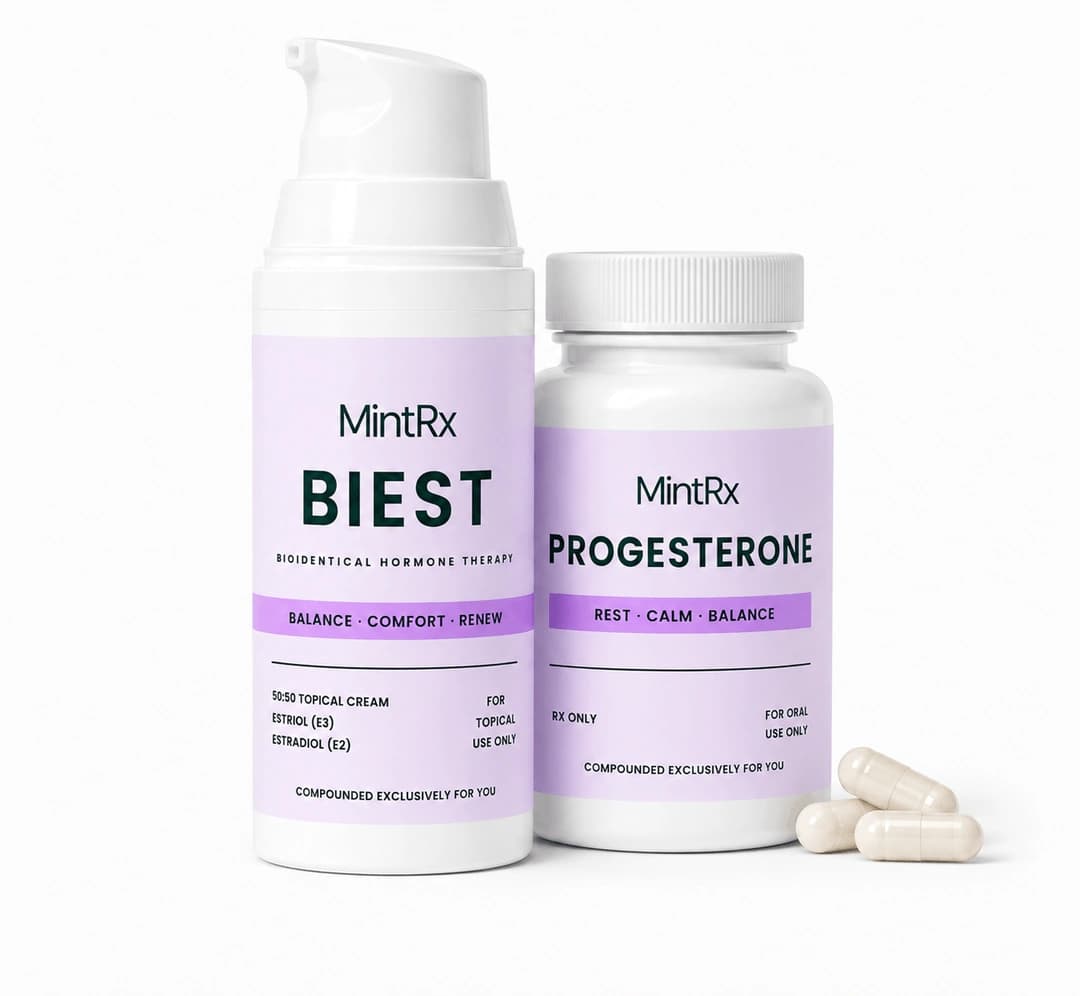
The treatment options built into MintRx's new Female HRT/TRT program include compounded Bi-Est, a combination of estriol and estradiol intended for systemic skin application, progesterone when appropriate, and vaginal therapies for specific needs. These are different tools, not a list everyone automatically receives.
Bioidentical describes a hormone's molecular structure, not how it was manufactured. FDA-approved bioidentical medicines exist too.
Compounded medications are not FDA-approved, and customization does not establish that they are safer or more effective. ACOG recommends FDA-approved menopausal hormone therapies over compounded preparations. When a compounded prescription is considered, the reason should be a specific patient need that an approved option does not meet.
Ask: ‘Why this formulation for me, how do I use it, and what will we review to decide whether it is helping?’ Those questions move the conversation beyond a label such as natural or personalized.
What should happen after the prescription?
The point of online care is not to send medication and leave you to figure out the rest.
MintRx's new Female HRT/TRT program is built around an initial pharmacist conversation, a review after program labs and monthly pharmacist check-ins. The licensed provider makes prescribing decisions. The pharmacist helps connect the plan to how treatment is actually going in your life.
That means remembering what you wanted help with, checking how you measure and apply the medication, reviewing other medicines and supplements, and asking what has improved or is still getting in the way.
If hot flashes are better but sex is still uncomfortable, that deserves its own conversation, not an automatic increase in systemic estrogen. If the routine is difficult, the next step may be practical help using it. If symptoms suggest another problem, the plan may need further evaluation. Prescription changes go through the prescriber.
A useful follow-up ends with a clear next step and someone responsible for it. You should not have to start your story over every time you have a question.
For a general overview of provider review, fulfillment and ongoing support, read what happens after you start treatment online. If you are unsure where a question belongs, the guide on when to call the pharmacy team explains medication support, prescribing decisions and order help.
When is online care not enough?
Tell the provider about unexplained bleeding, a new breast change or persistent pelvic pain rather than assuming menopause explains it. Bleeding after menopause needs medical evaluation, even when it is light or happens only once. Report new or unexpected bleeding while using HRT too.
A history of hormone-sensitive cancer, blood clots, stroke, heart attack or liver disease can change whether systemic treatment is appropriate and may call for specialist input. An online conversation can identify the next step, but it cannot replace a needed examination.
Chest pain, sudden shortness of breath or signs of stroke need emergency care. Call 911 rather than waiting for a portal reply.
Being directed to in-person care when it is needed is part of good care, not a failure of telehealth.
Start with what you want to be different
Bring one sentence that describes the change you want: fewer interrupted nights, more vaginal comfort or a clearer understanding of what is happening. That gives you and your care team something meaningful to work toward and review.
You do not have to choose your hormone treatment before asking for help. Talk with a MintRx pharmacist about your medication questions and the next step in exploring care.
Online should describe where the conversation happens, not how alone you feel afterward.
Sources
- ACOG: Hormone Therapy for Menopause
- The Menopause Society: 2022 Hormone Therapy Position Statement
- NICE NG23: Menopause, identification and management
- FDA: Compounding and the FDA, Questions and Answers
- ACOG: Compounded Bioidentical Menopausal Hormone Therapy
NICE is UK clinical guidance, not a US prescribing rule. Your US clinician determines the assessment and treatment appropriate for you.
Keep reading
Need help with your next step?
Start with Client Care. We can help with account and order questions or route you to the right clinical or pharmacy resource.