

What should you ask before considering sermorelin injections?
Considering sermorelin injections? Ask about evidence, compounded medicines, risks, monitoring, and pharmacist support before deciding on treatment.
Clinically reviewed by Nathan Parker, PharmD. Last reviewed: November 6, 2026.
Before considering sermorelin injections, ask three things: What are we trying to improve, what evidence supports using sermorelin for that goal, and how will we know whether it's helping? Then get practical: what you'll receive, how to prepare and use it, what it costs, and who can help when questions come up. You don't need to arrive knowing which prescription you want. You do need a clear reason for treatment and a plan you understand.
Start with your concern, not an injection schedule. Ask what needs to be evaluated before choosing treatment.
Sermorelin stimulates growth hormone release. That does not, by itself, prove better energy, sleep, recovery or a longer life.
Compounded sermorelin is not FDA-approved. Ask why that preparation is being considered and what evidence supports the proposed use.
Leave with a clear plan for injection training, storage, follow-up, total costs and questions between visits.
Six questions to bring to your consultation
Start with the reason for treatment, not the injection schedule. If you're exploring MintRx's sermorelin treatment option, use the consultation to connect your concerns with a specific plan. A licensed provider decides whether prescribing is appropriate.
Bring these questions to your consultation:
What are we evaluating? Describe what you want to address, when it started, and how it affects daily life. Ask whether your symptoms need further evaluation before discussing medication.
What evidence applies to my goal? Ask whether the evidence concerns your intended use, the injectable formulation, and people with a similar medical situation.
What could make treatment inappropriate? Review your health history, current medicines, supplements, allergies, and any pregnancy or breastfeeding considerations.
What exactly would be prescribed? Ask about the formulation, dispensing pharmacy, administration instructions, and whether preparation is required before use.
How would we judge the result? Agree on what improvement would matter to you, when you'll reassess it, and what would lead the provider to change or stop the plan. Ask what any recommended laboratory testing can and cannot tell you.
Who handles questions afterward? Know how to reach the prescribing team, the pharmacy, and account support before treatment starts.
Bring a current list of medicines and supplements, including occasional medicines, plus any relevant test results. Write down when your concern started and what you've already tried. ‘I'm exhausted by midafternoon even when I sleep through the night’ gives the provider more to work with than ‘I want better energy.’ It's a starting point for evaluation, not a diagnosis.
What can sermorelin actually tell us about your goal?
Sermorelin signals the pituitary gland to release growth hormone. It is not the same medicine as growth hormone replacement. Understanding that mechanism is useful, but it doesn't answer the question most people care about: Will this help with the problem that brought me here?
Early human research has examined sermorelin and related growth hormone-releasing approaches in older adults. A 2001 peer-reviewed review described preliminary changes in hormone levels and body composition, but the authors emphasized that the findings did not establish a basis for treating aging. Sleep findings were not consistently favorable, either. That research is a reason to ask better questions, not a promise of better sleep, recovery or longevity.
Ask: ‘What did the study actually measure, and how closely does the treatment studied match the one you're proposing?’ A change in a blood test is not automatically a change you'll notice in daily life. Research on a different peptide, formulation or patient population may not answer your question.
For longevity claims, keep the distinction especially clear. In its 2023 summary on hormones and aging, the Endocrine Society stated that no therapy to increase growth hormone secretion or action was approved as an anti-aging intervention and that risks may outweigh benefits. Ask what can be supported for your specific goal, not whether the treatment sounds promising in general.
Is the prescribed sermorelin compounded?
Ask what will actually be in your prescription: sermorelin alone or a combination, the strength, and which pharmacy will dispense it. A familiar ingredient name doesn't tell you everything about the finished medicine.
Compounded medicines are not FDA-approved. As FDA explains in its compounding questions and answers, the agency does not verify their safety, effectiveness or quality before marketing. Compounding can meet a medical need, but ask why a compounded preparation is being proposed for you and whether an FDA-approved option could meet that need.
Before using it, confirm that the label, preparation instructions and supplies match what the pharmacy explained. If they don't, contact the pharmacy before your first injection.
What would make treatment worth continuing?
Agree on the follow-up plan before the first injection, not when you're already deciding whether to order another vial.
Ask these questions:
What would count as meaningful improvement for my goal?
When will we check in, and what should I track before then?
Which tests, if any, are needed, and how would the results change the plan?
What would make us stop, change course or investigate another cause?
If growth hormone deficiency is being considered, ask how that diagnosis would be established. The Endocrine Society's adult growth hormone deficiency guideline explains that confirmation usually requires stimulation testing, with exceptions. Feeling tired or noticing age-related changes is not, by itself, that diagnosis.
You don't need to arrive with a preferred prescription. A clear description of your concerns is more useful than trying to match yourself to a product.
What risks and practical limitations should you discuss?
Ask for the risks associated with the exact prescribed preparation and your medical history. A generic statement that treatment is well tolerated doesn't explain what you need to watch for.
Discuss injection-site discomfort or irritation, possible allergic reactions, and any other adverse effects the provider identifies as relevant. Ask which symptoms require a routine message, prompt clinical assessment, or emergency care. Trouble breathing or swelling of the face or throat requires emergency medical attention. Call 911 rather than waiting for a portal reply.
Also discuss the practical burden. Preparing supplies, giving injections, following storage instructions, and attending follow-up are part of treatment, not details to work out after delivery.
Before agreeing, ask:
Can I follow the preparation and administration instructions reliably?
What should I do if I miss a dose, spill some medicine or am unsure how much I injected? Don't take an extra dose to make up for uncertainty. Ask the pharmacist or prescribing team for instructions.
How should I report a suspected side effect?
What happens if I can't complete the follow-up plan?
Don't change your dose or administration schedule on your own. Contact the prescribing team or pharmacist for instructions that apply to your prescription.
What should happen before the first injection?
You shouldn't have to guess at a syringe marking or mixing instruction. Before you start, ask the pharmacist to walk through the actual vial, supplies and directions you'll be using.
Preparation: Does the vial need mixing? Which liquid and amount belong with this prescription? Use the pharmacy's directions, not a video for a different product.
Measuring: Ask the pharmacist to show you the correct amount on the supplied syringe. If the label uses milliliters and the syringe uses units, have the pharmacy confirm the matching marking. Don't copy another person's number of units.
Technique: Ask for a demonstration of preparation, injection technique and safe handling. Then explain the steps back so anything unclear gets caught before you inject.
Storage and travel: Ask where the medicine belongs before and after mixing, what to do if a shipment arrives warm, and whom to call after a temperature problem. Have the pharmacy assess the situation rather than guessing whether the vial is still usable.
Discard date: Confirm the pharmacy-labeled beyond-use date and any shorter discard period after mixing or first use. Having medicine left in the vial doesn't extend that date.
Disposal: Place used needles and syringes immediately in an appropriate sharps container. Don't put loose sharps in household trash or recycling, or flush them down the toilet.
FDA's guide to safe sharps disposal explains container options and safe handling. For questions about your prescription, MintRx's guide to when to call the pharmacy team can help you find the right contact.
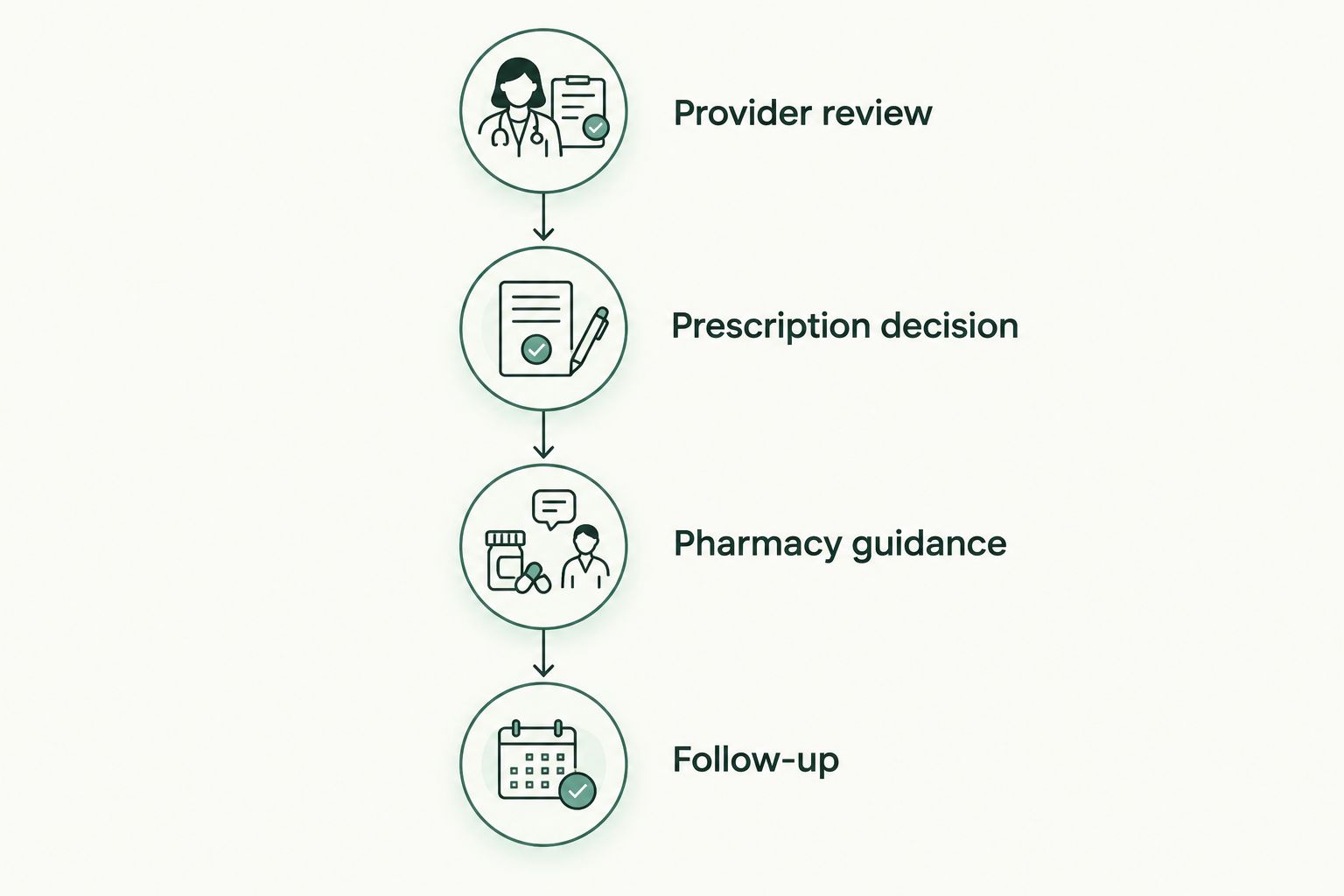
The prescription decision and pharmacy instructions come before treatment begins.
What should you ask about the total care commitment?
Before starting, request an explanation of medication charges, consultation charges, supplies, shipping, and any recommended testing or follow-up. Ask which items are included and which are separate. If you're choosing automatic refills, ask what you'll be charged today and at each refill, how often billing happens, and how to pause or cancel before the next charge. Ask what happens to billing if the provider wants reassessment before continuing.
Don't assume an advertised medication amount represents the entire care plan. Also clarify refill procedures and what happens if the provider recommends reassessment before another prescription. Ask about any terms that affect your decision before agreeing to them.
Your time matters too. Consider whether you can manage the administration instructions, attend follow-up, and contact the care team when questions arise. A plan is only useful if you understand what participating in it requires.
What does the online care process involve?
MintRx's guide to what happens after you start treatment online explains the path from provider review to pharmacy fulfillment and follow-up. A prescription is provided only when clinically appropriate.
The provider handles diagnosis and treatment decisions. The pharmacist helps with medication directions, preparation, storage and medication concerns. Client Care helps with accounts, orders and getting your question to the right team.
Use the secure care path for treatment-specific information. Don't put sensitive medical details in a general contact form.
FAQ
Are sermorelin injections FDA-approved?
Compounded sermorelin injections are not FDA-approved. There were previously FDA-approved sermorelin products under the name Geref for specific pediatric treatment and diagnostic uses. FDA later determined that those products had not been withdrawn from sale for reasons of safety or effectiveness. That history does not give today's compounded preparations FDA approval or establish an approved anti-aging use.
Can sermorelin injections guarantee better energy or longevity?
Sermorelin injections can't guarantee better energy or longevity. Preliminary research doesn't establish those benefits for today's compounded preparations; ask what evidence supports your specific goal, not just changes in blood tests.
Do I need laboratory testing before considering sermorelin?
Your licensed provider decides what evaluation or laboratory testing is appropriate. Ask what each proposed test would clarify and how its result would affect the treatment decision.
What side effects should I ask about before starting?
Ask about injection-site reactions, allergic reactions, and other risks relevant to your prescribed preparation and health history. Know whom to contact for side effects; call 911 for trouble breathing or swelling of the face or throat rather than waiting for a portal reply.
Can I follow someone else’s sermorelin injection schedule?
Do not follow another person’s sermorelin injection schedule. Use only your prescribed instructions, and contact the pharmacist or prescribing team before making changes.
What should I ask about sermorelin treatment costs?
Ask about medication, consultations, supplies, shipping, and any recommended testing or follow-up, including what's separate. If you're considering automatic refills, confirm charges and how to pause or cancel.
Who can answer medication questions after delivery?
A MintRx pharmacist can help with medication questions after delivery. Licensed providers make treatment decisions, while Client Care handles account and order questions and routes requests.
One last thing
Before your consultation ends, explain the plan back in your own words: what treatment is intended to address, what remains uncertain, and whom you will contact with a concern. If any part is unclear, ask for clarification before the first injection.
Have a question about mixing, measuring, storage or what to ask before you start? Talk with a MintRx pharmacist. You don't have to figure out the pharmacy side on your own.
Related guides
Sources
Growth hormone-releasing hormone and aging: a 2001 review with preliminary human findings.
Endocrine Society: Evaluation and Treatment of Adult Growth Hormone Deficiency, 2011.
FDA: 2013 determination concerning discontinued Geref products, via the Federal Register on GovInfo.
FDA: Safely Using Sharps (Needles and Syringes) at Home, at Work and on Travel.
Keep reading
Need help with your next step?
Start with Client Care. We can help with account and order questions or route you to the right clinical or pharmacy resource.