
Longevity
What evidence should you review before getting NAD injections online?
Human research on NAD+ injections is thin. How to check route, study size and outcomes, what FDA has flagged about sterile NAD+, and what to ask.

Before getting NAD+ injections online, look for human research that matches the exact ingredient, the injection route and the outcome you care about, not just explanations of how NAD+ works in cells. Then check how the injection is made, what problems have been reported and who you'll call with questions. A licensed provider should be able to tell you what the evidence supports, what's still uncertain and whether treatment makes sense for you.
Reviewer: Nathan Parker, PharmD.
What evidence should you review before getting NAD injections online?
For any proposed NAD injection, ask for evidence that answers a practical question: Does this treatment improve the outcome you care about in people like you? A description of how NAD works in cells does not answer that question.
Use this evidence checklist before deciding:
- Human outcomes: Did researchers measure symptoms, daily functioning, or another meaningful health outcome, not only a laboratory value?
- Matching formulation: Did participants receive NAD+, rather than a different NAD-related ingredient?
- Matching route: Was treatment given by the same injection route being proposed to you?
- Study quality: Was there a comparison group, and how were participants assigned to treatment?
- Safety reporting: Did the report describe adverse reactions, withdrawals, and follow-up?
- Relevant participants: Were participants similar to you in the health issue being studied and relevant medical history?
Ask for the full study citation, not a screenshot or a sentence from an advertisement. Read the conclusion alongside the methods and limitations. Evidence for a biological mechanism is not the same as evidence of a patient benefit.
What does the human research on NAD+ injections show?
Less than the marketing suggests. Most NAD+ research in people has used oral precursors such as nicotinamide riboside (NR) or NMN, not NAD+ itself, and those are different ingredients.
For injected NAD+, the human data are small and mostly about what happens in the body, not how people feel:
- A 2019 pilot study gave 8 healthy men a 6-hour IV infusion of NAD+, with 3 controls. Blood NAD+ didn't rise for the first 2 hours, which suggests the body clears or breaks it down quickly. It measured blood and urine levels, not energy or symptoms.
- A 2026 preprint, not yet peer reviewed, reported two small pilot trials, mostly of injected NR. In one, 6 people received NAD+ under the skin for three days. The injections were generally tolerated, with some discomfort. It was a short safety study, not a test of benefit.
That's the honest picture for an under-the-skin NAD+ injection: early, small and mostly about tolerability. It's a reason to set clear expectations with your provider, not a promise of more energy, sharper focus or slower aging.
Why this matters
NAD stands for nicotinamide adenine dinucleotide, a molecule involved in cellular processes, including energy metabolism. That biological role does not establish that injecting additional NAD improves energy, slows aging, or treats a particular symptom.
Separate three questions: what the molecule does, what the proposed treatment has demonstrated, and whether that treatment fits your medical situation. Each needs its own answer. A persuasive explanation of the first cannot substitute for the other two.
This distinction also protects your time. If your main concern is persistent fatigue or another new symptom, ask the provider whether it needs evaluation before discussing a wellness treatment. An online treatment request should not replace an assessment of the concern that brought you there. Our guide on testing before B12 injections shows what that kind of evaluation can look like for one common cause.
Which kinds of evidence deserve the most weight?
Different sources answer different questions. Use the comparison below to identify what a claim actually rests on, rather than treating every reference as equal proof.
| Evidence source | Best for | What it can contribute | Main limitation |
|---|---|---|---|
| Controlled human trial | Evaluating treatment effects | Compares outcomes between treatment groups | Results apply to the studied participants, formulation, and conditions |
| Observational human study | Identifying patterns in practice | Describes outcomes without assigning treatment experimentally | Other differences between participants can affect results |
| Laboratory or animal study | Explaining a possible mechanism | Helps researchers investigate biological processes | Does not establish benefit in people |
| Patient testimonial | Understanding an individual experience | Describes what one person reports | Cannot establish cause, typical results, or safety |
| Regulatory safety notice | Identifying recognized safety concerns | Describes problems requiring attention | Does not provide a complete estimate of treatment benefit or risk |
A controlled trial still needs scrutiny. Ask what the comparison group received, whether participants and researchers knew the assignment, and how missing results were handled. A study can be useful without answering every question, but its limitations should stay attached to the claim.
Also check who funded the research and whether the authors disclosed financial relationships. Industry funding does not automatically invalidate a study. It does make clear methods, complete reporting, and independent confirmation especially important to examine.
Injection evidence must match the proposed injection route
The word injection is not a complete treatment description. Intravenous administration delivers a substance into a vein; subcutaneous administration delivers it under the skin; intramuscular administration delivers it into muscle. Evidence about one route does not automatically establish the effects or risks of another.
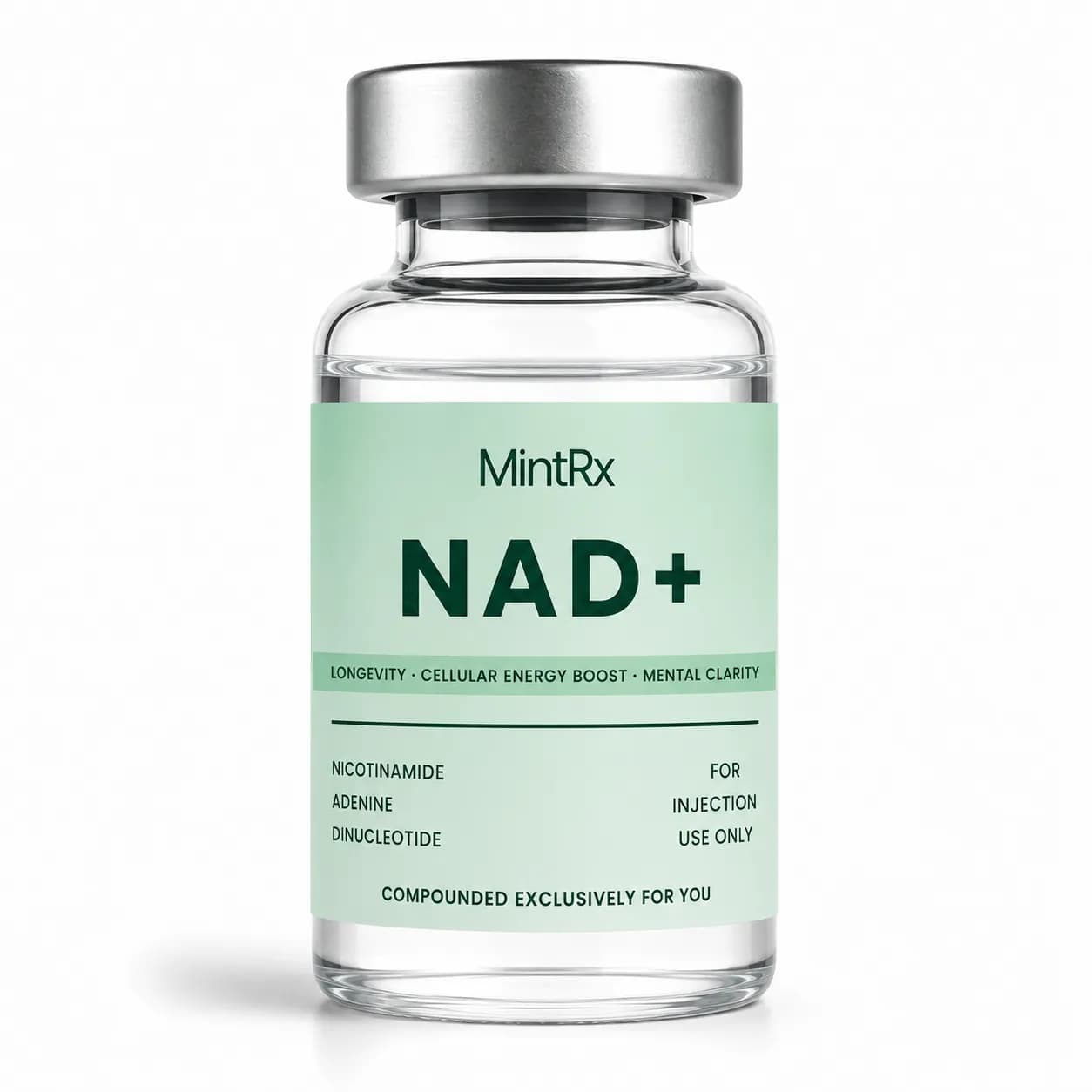
MintRx's NAD+ Injection is a pre-mixed 100 mg/mL vial for subcutaneous use, meaning under the skin, at home only. It isn't for IV or intramuscular use, and results or experiences from IV clinics don't transfer to it.
Ask the provider to name the route being considered and show how the cited research relates to it. Check whether the study used the same ingredient, formulation, treatment setting, and schedule. Do not use a research protocol as instructions for treating yourself.
If the evidence concerns an infusion delivered under clinical supervision, ask what supports applying those findings to the proposed setting. That is a question about the limits of the evidence, not a reason to assume the treatments are equivalent.
Does NAD+ nasal spray research support NAD+ injections?
Nasal spray research does not, by itself, establish the benefits or safety of an injection. The administration route is part of the treatment being studied, not a minor packaging detail.
The reverse is also true: injection findings do not automatically support a nasal formulation. Ask for route-specific evidence rather than accepting a general reference to “NAD research.”
MintRx also offers an NAD+ nasal spray. It's a separate product with its own instructions, and evidence for one doesn't cover the other.
Do oral NAD-related studies support injections?
Studies of oral NAD-related ingredients do not directly establish the effects of injected NAD+. Check the actual ingredient named in the paper rather than relying on a broad category label.
An increase in a measured NAD-related marker also needs interpretation. Ask whether researchers demonstrated an improvement in the outcome you want, and whether that improvement was meaningful to participants.
What safety evidence should you ask about?
Ask about the medicine and about how it was made. For an injection, ingredient quality and sterile preparation are separate questions from whether NAD+ has a plausible role in your cells.
In 2024, FDA reported adverse events after injectable NAD+ products, including severe chills, shaking, vomiting and fatigue, with some people needing medical treatment. FDA said the reactions were consistent with excessive endotoxins, bacterial components that can trigger serious reactions, and warned compounders against using food-grade NAD+ to make IV products. That notice doesn't tell you how often reactions happen or implicate every NAD+ product. It's still a fair reason to ask what grade of ingredient a pharmacy uses and how its sterile products are tested.
Compounded drugs aren't FDA-approved, and FDA doesn't verify their safety, effectiveness or quality before they're marketed.
For MintRx's NAD+ injection, the listed effects are usually mild and can be dose-related: soreness or redness where you inject, nausea, headache, temporary fatigue, lightheadedness and flushing. It isn't used during pregnancy or breastfeeding or with active cancer, so tell the provider about any cancer history and every medicine you take. Trouble breathing, swelling of the face or throat, chest pain or fainting is an emergency: call 911. For persistent or severe symptoms, stop and contact the prescriber.
Before treatment, ask:
- Which licensed pharmacy will prepare or dispense the medicine?
- Is the proposed medicine compounded?
- What can the pharmacy explain about ingredient suitability and sterile preparation?
- What reactions should prompt a call, and which require emergency care?
- Who handles medication questions after delivery?
- What written storage, handling, and disposal instructions accompany the prescription?
What should a licensed provider review before prescribing?
A treatment decision should connect your goal with your health history and the relevant evidence. Tell the provider about your symptoms, medical conditions, medications, supplements, allergies, and previous reactions. Include pregnancy or breastfeeding when relevant.
Ask what information is still needed before a decision. Depending on your concern, the provider should explain whether further assessment or in-person care is appropriate. Do not assume that selecting a product means a prescription will follow.
Useful questions include:
- “What specific outcome are we trying to improve?”
- “What evidence supports this exact treatment for that outcome?”
- “What are the meaningful risks and uncertainties?”
- “What other evaluation or treatment should I consider?”
- “How will we decide whether continuing treatment makes sense?”
A useful answer explains limitations as clearly as potential benefits. It should leave you able to describe the reason for treatment in your own words, without relying on a promise of better longevity or energy.
Who helps once you start?
A licensed provider reviews your information and decides whether NAD+ is appropriate; an online request doesn't guarantee a prescription. If it's prescribed, a MintRx pharmacist can help with the label, the supplied syringes, storage and other medication questions. Our guide on when to call the pharmacy team explains who handles what.
How should you compare the practical details?
Know exactly what arrives and how to handle it before you agree to treatment. MintRx's NAD+ injection ships refrigerated as a pre-mixed vial, so there's nothing to mix, with insulin syringes marked in units and alcohol wipes. Keep it in the refrigerator, away from light, and never freeze it. Write the first-puncture date on the label: the vial is discarded 28 days later, even if medicine is left. Because the syringes are marked in units, have the pharmacist confirm what your prescribed amount looks like on that syringe before your first dose.
Confirm these details before agreeing to treatment:
- The exact prescribed formulation and administration route.
- Any supplies and instructions needed for the prescribed treatment.
- The process for medication questions and follow-up.
- What to do if the package, label, or instructions appear incorrect.
- How to contact the pharmacy and how to reach Client Care.
Keep the written instructions and pharmacy information accessible. If instructions conflict or something is unclear, ask the pharmacy or prescribing provider before using the medicine. Do not resolve uncertainty by borrowing instructions from another formulation or another person's prescription.
FAQ
Does NAD's role in cellular energy prove injections improve energy?
NAD's role in cellular energy does not prove that NAD injections improve how you feel. Ask for human research measuring the specific symptom or outcome you want to address.
Can research on NAD nasal spray prove injections work?
Research on NAD nasal spray does not by itself establish that injections work. The ingredient, formulation, administration route, and measured outcomes must match the claim being made.
Are compounded NAD injections FDA-approved?
No. Compounded NAD+ injections aren't FDA-approved, so FDA hasn't verified their safety, effectiveness or quality. Ask about the exact formulation, how it's prepared and what evidence supports your goal.
What safety concerns should I discuss about injectable NAD?
Ask about ingredient grade and sterile preparation, expected side effects such as nausea or flushing, and what to do if something feels wrong. In 2024, FDA reported severe chills, shaking, vomiting and fatigue after some injectable NAD+ products and said those reactions were consistent with excessive endotoxins.
Is an at-home NAD+ injection the same as an NAD+ IV drip?
No. MintRx's NAD+ injection is for subcutaneous use at home only. An IV infusion is a different route given under supervision, and research or experiences from IV clinics don't transfer to an under-the-skin injection.
One last thing
A study can be genuine and still fail to support the claim beside it. Before accepting a treatment recommendation, ask the provider to identify the study's ingredient, route, participants, and measured outcome. Those details reveal whether the reference answers your question or a different one.
Have a question about the evidence, the syringes or storage? Talk with a MintRx pharmacist, or compare all longevity treatments.
Sources
- Grant and colleagues, A pilot study investigating changes in the human plasma and urine NAD+ metabolome during a 6 hour intravenous infusion of NAD+, 2019
- Nkrumah-Elie and colleagues, Preliminary safety analysis of two pilot clinical trials involving injections of nicotinamide riboside chloride, 2026 preprint
- FDA: FDA reminds compounders to use ingredients suitable for sterile compounding (2024)
- FDA: Compounding and the FDA: Questions and Answers

